Every ward, one patient record

Bridge HMS runs the whole patient journey on one system: reception, appointments, consultation, EHR, lab, radiology, pharmacy, wards, theatre, billing and insurance claims. Forty departmental apps, switched on per facility, all writing to the same record.

Free instant access. No credit card required. Priced per practitioner.

Apps in the suite
  • HMS Core
  • Reception
  • Appointments
  • Consultation / OPD
  • Electronic Health Record
  • Laboratory
Bridge HMS Suite: Every ward, one patient record

Register once, queue by priority

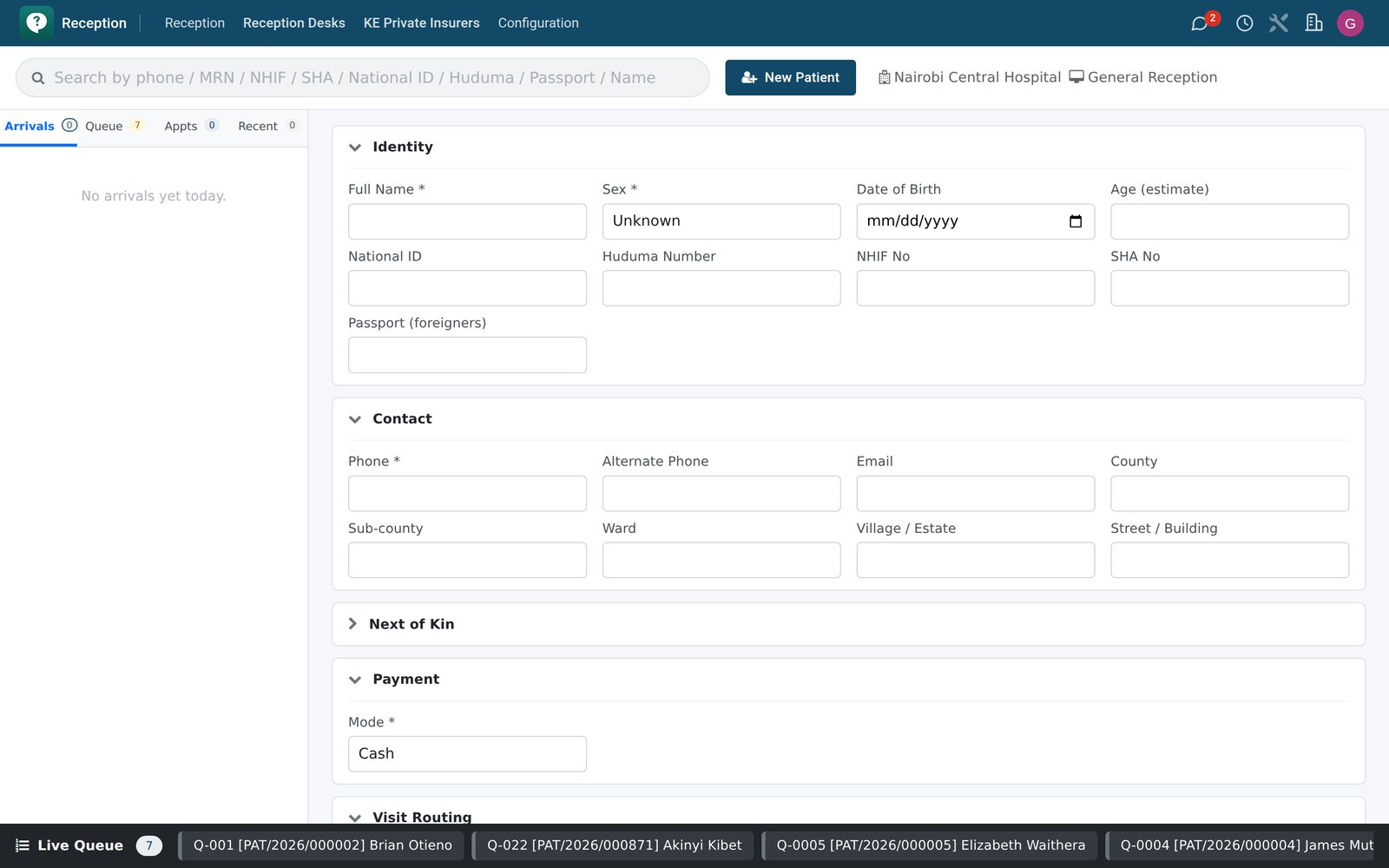
One search box matches phone, national ID, national insurance number such as NHIF/SHA, MRN or name and branches to a returning-patient visit or a guided new-patient intake. Every arrival gets a printed queue ticket, a triage priority and a live wait estimate.

Reception — Reception desktop

Reception desktop

Reception

Six payment modes at the desk

Cash, mobile money such as M-Pesa, national insurance such as NHIF/SHA, private insurer, corporate account or a deposit, captured before the patient leaves the desk, so the bill is already routed.

Explore Reception →
Reception

Eligibility at registration

Insurer catalogue and policy fields sit inside the intake wizard; eligibility is verified before the visit starts, not at the cashier.

Explore Reception →

The chart clinicians stay inside

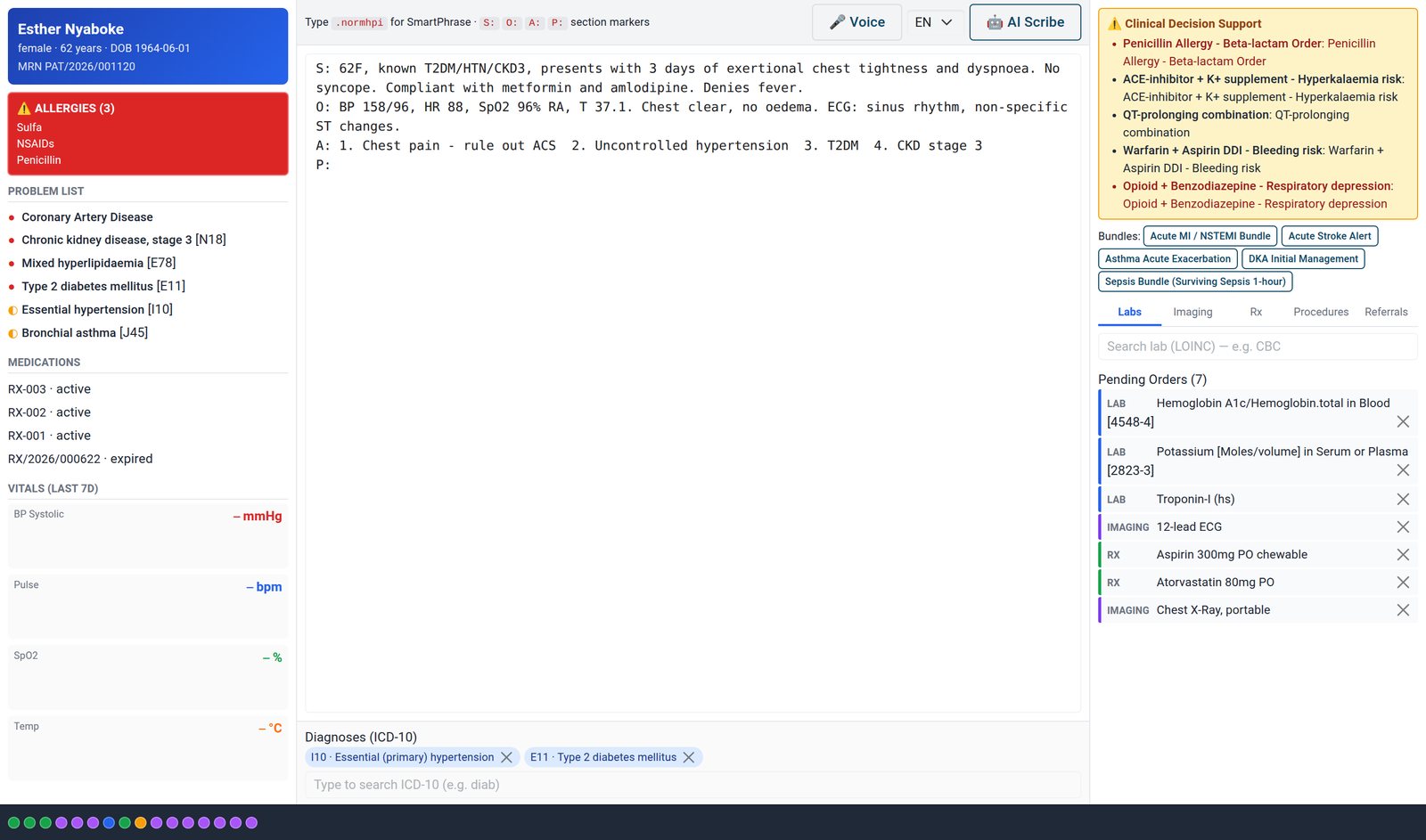
A full-screen, three-pane chart workstation: allergy banner and problem list on the left, SOAP note with dot-phrase autocomplete in the middle, tabbed order pads on the right. Lab, imaging, prescription and referral orders leave the screen priced and routed.

Electronic Health Record — EHR chart workstation

EHR chart workstation

Electronic Health Record

Decision support that interrupts

Drug-drug interaction and allergy cross-checks fire while the order is typed; hard-stop severities block the order until acknowledged.

Explore Electronic Health Record →
Electronic Health Record

Draft safety

Thirty-second auto-save, chart session tokens and a soft lock with a conflict banner when two clinicians open the same encounter.

Explore Electronic Health Record →
Bria Clinical AI

Bria ambient scribe

Record the encounter, queue it to the scribe, and receive a SOAP draft on the chosen template for the clinician to sign.

Explore Bria Clinical AI →
A doctor in a white coat writes notes at her desk while a young patient waits
Electronic health record in BridgeERP HMS
Clinical Decision SupportPenicillin Allergy · Beta-lactam Order

Doctors

The whole chart on one screen

  • Problems, medications, vitals and allergies beside the note
  • Allergy and interaction warnings as orders go in
  • Lab, imaging and prescription orders from the same screen

What runs behind the consultation

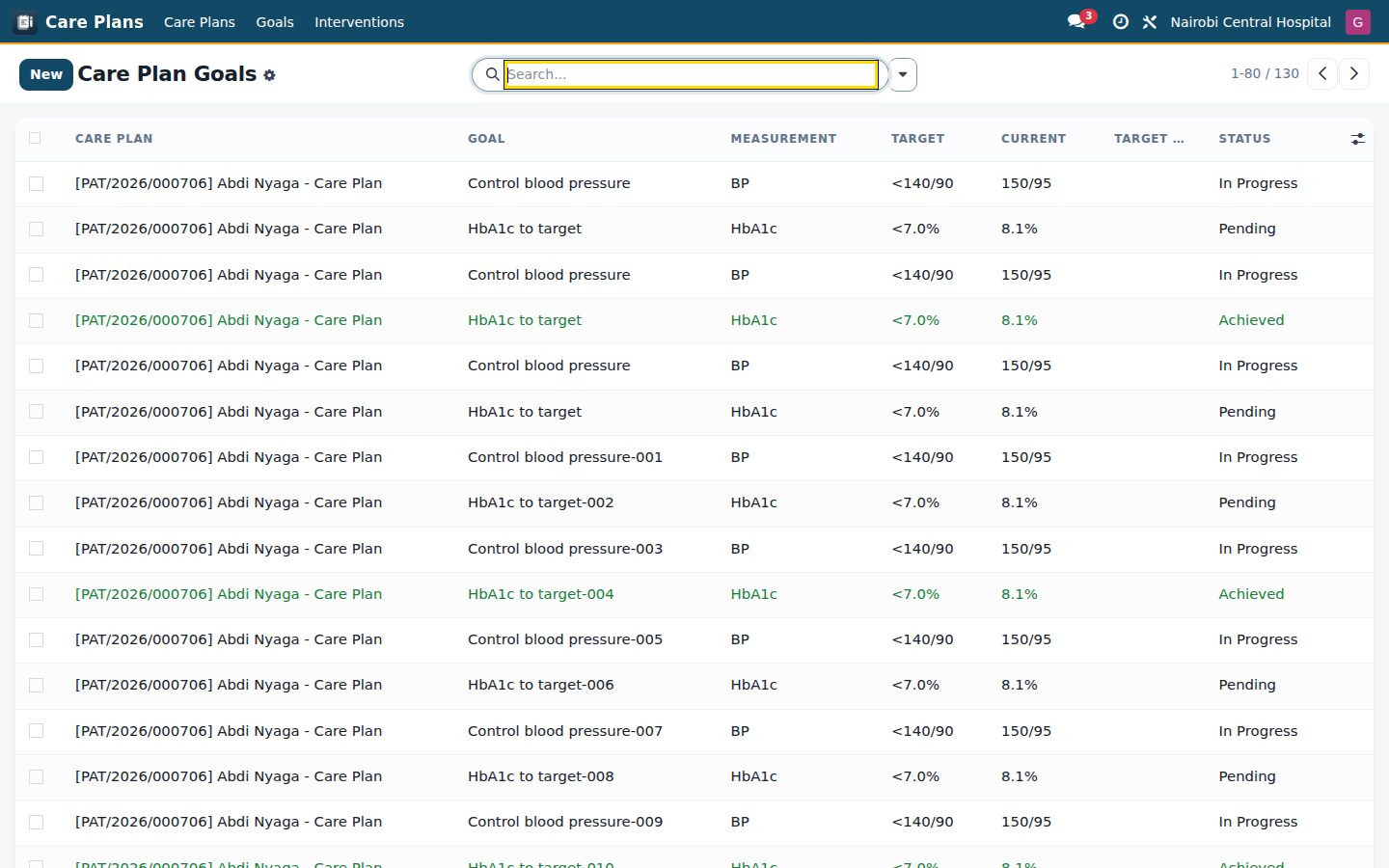
Each department is an app on the same patient record. Orders leave the consultation and arrive at the bench, the modality, the dispensary or the theatre list without re-keying.

  • Consultation / OPD

    SOAP notes with a four-field completion guard, structured dosing vocabulary, 30 seeded interaction pairs, referrals to 18 specialties and a legal amendment trail.

  • Laboratory

    80+ LOINC-coded tests with age and gender-banded ranges, Code128 sample barcodes, chain-of-custody, multi-step validation and critical-value alerts.

  • Radiology & PACS

    Multi-modality ordering, modality-specific report templates, contrast-allergy safety check, laterality and body part, PACS viewer deep-link.

  • Pharmacy

    Prescription-to-dispense loader with allergy and interaction guards, batch and expiry stock, two-witness controlled substances and an OTC walk-in till.

  • Operating Theatre

    Ten-stage surgery lifecycle, double-booking prevention, three-phase WHO safety checklist, anaesthesia record, PACU Aldrete scoring and implant traceability.

  • Emergency

    Five-level ESI triage, colour-coded live whiteboard, ABCDE trauma sheet with GCS / RTS / ISS scores, NEWS2 observations and mass-casualty activation.

Samples to validated results, tracked

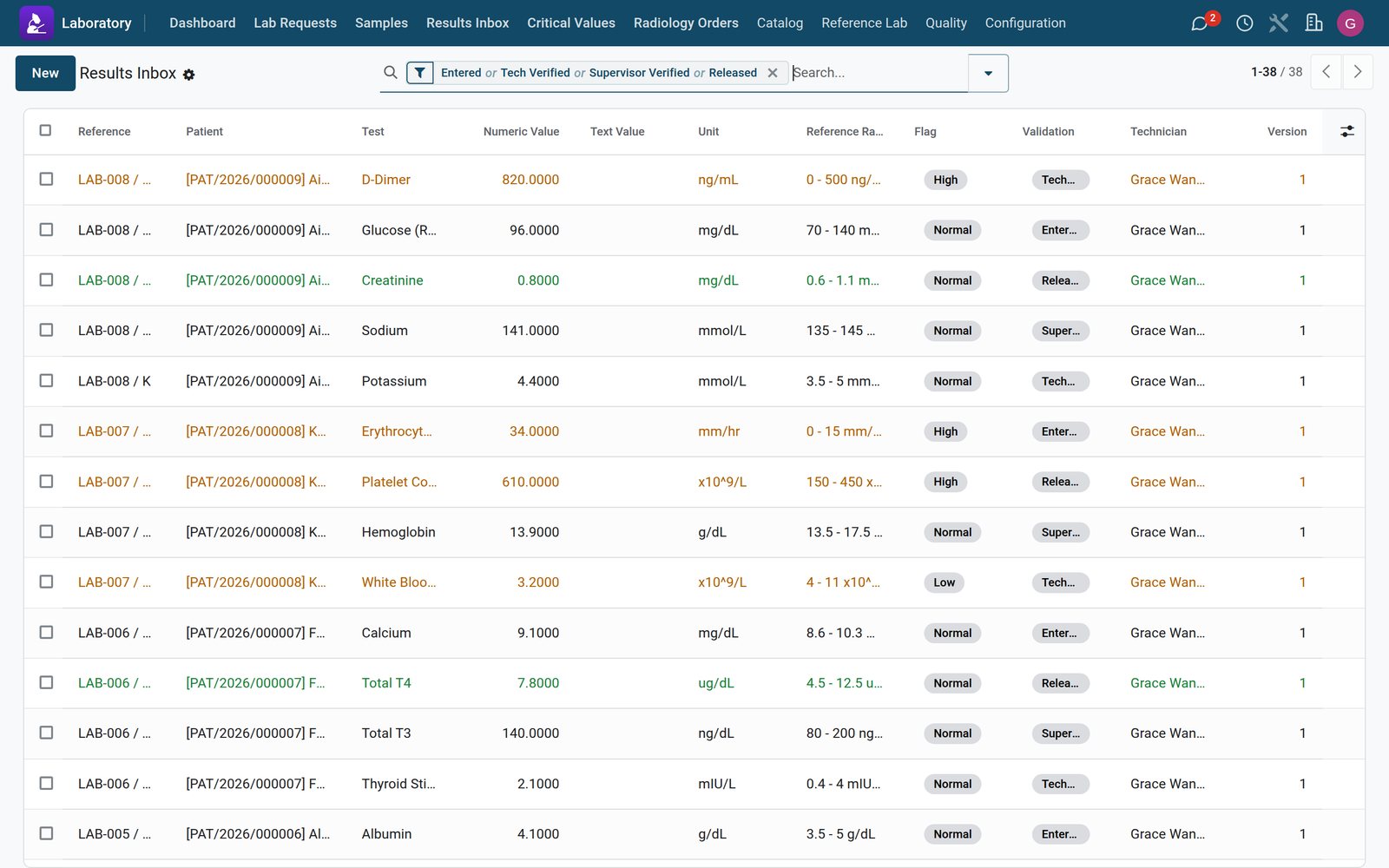
A lab request expands its panels automatically, prints a barcode label, logs custody at every hand-off and lands in the Results Inbox where values are auto-flagged against the patient's reference range before a supervisor releases them.

Laboratory — Results Inbox

Results Inbox

Laboratory

Turnaround measured

TAT per test is reported and breaches escalate automatically; the emergency panel has its own SLA.

Explore Laboratory →
Laboratory

Westgard QC built in

QC materials, run log, automatic Z-score and multi-rule flagging, plus EQA pass/fail scoring for accreditation files.

Explore Laboratory →
Laboratory

HL7 and FHIR out of the box

ORU^R01 builder and parser, FHIR R4 Observation and DiagnosticReport builders for analyser and referral interfaces.

Explore Laboratory →
A pharmacist in a white coat and hijab holds boxes of medicine
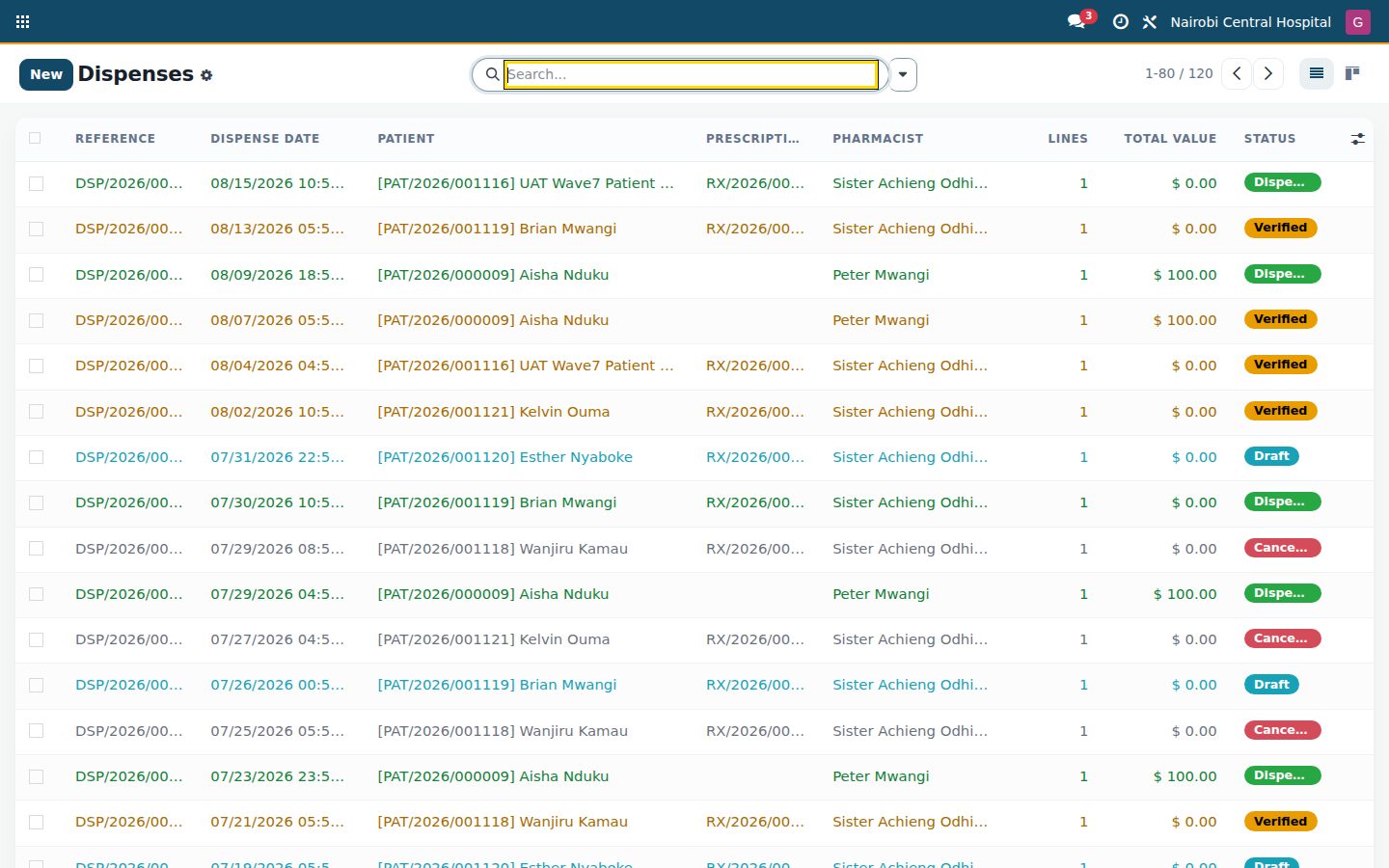
Pharmacy dispensing list with verified prescriptions
DSP/2026/000045Dispensed · 2,027.00 KSh

Pharmacy

Dispensed against the prescription

  • Each dispense tied to the doctor's prescription
  • Verified by a pharmacist before it goes out
  • Batches and expiry tracked in stock

Charges capture themselves

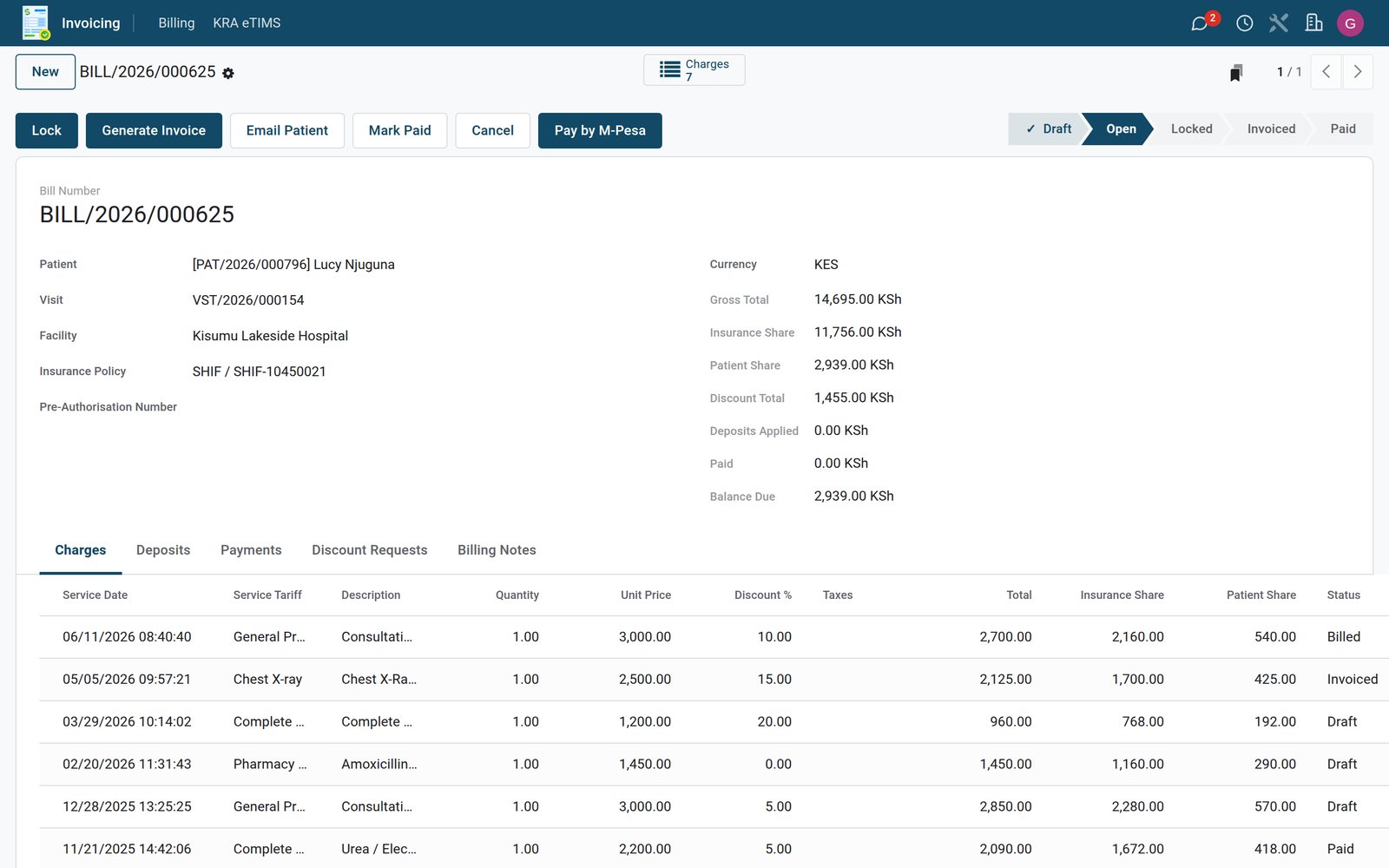
A completed consultation, a validated lab result, a released imaging report or a dispensed drug each posts its own charge to the visit bill. The cashier sees one consolidated bill, split between insurer and patient, with deposits already applied.

Billing & Cashiering — Visit bill with insurer split

Visit bill with insurer split

Billing & Cashiering

Cash sessions that reconcile

Cash registers, shift sessions and an end-of-shift reconciliation report per cashier.

Explore Billing & Cashiering →
Billing & Cashiering

Discounts with a paper trail

Reason-coded discount requests routed to a manager, approval audit trail, proportional distribution across lines.

Explore Billing & Cashiering →
Billing & Cashiering

Refunds and credit notes

Structured refund records with approval, automatic credit-note generation and a lock once processed.

Explore Billing & Cashiering →

Inside Insurance & Claims

From pre-authorisation to the insurer's remittance statement, the revenue cycle lives on the same bill the cashier saw.

  • Pre-authorisation

    Service-type classification, ICD-10 and procedure coding, clinical justification, attachments and an estimated amount per request.

  • Eleven-state claim lifecycle

    Claims auto-created from billing, charges pulled in, filing deadlines enforced, full or partial approval recorded.

  • Batches and six channels

    Claims auto-attach to a submission batch; batch PDF, e-mail or API submission with totals rolled up per scheme.

  • National insurer API client

    Pre-auth, claim and batch submission over a national insurer's API, such as SHA / SHIF, with retry, timeout handling and claim-status polling.

  • Remittance reconciliation

    Statement lines auto-matched to claims, matched vs unmatched totals, posted back to the claim record.

  • Appeals

    Eight-state appeal workflow from a rejection, new documentation attached, decision drives the claim state and revised amount.

A laboratory technician in safety glasses pipettes a sample
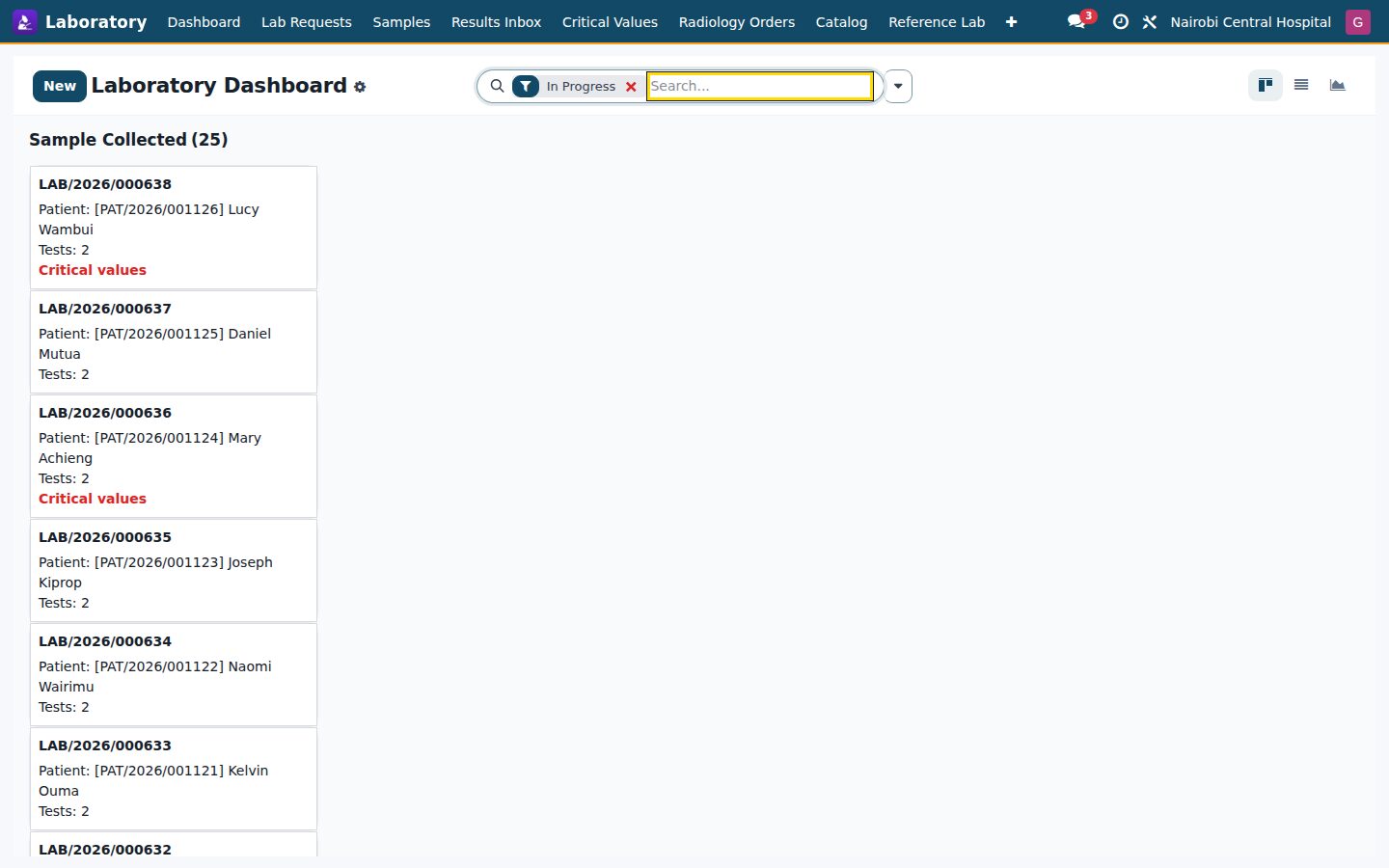
Laboratory dashboard with collected samples and critical values
LAB/2026/000638Critical values

Laboratory

Every sample tracked, every critical value flagged

  • Samples tracked from collection to result
  • Critical values flagged on the sample
  • Turnaround breaches shown before anyone has to chase

Admission to discharge, nothing re-entered

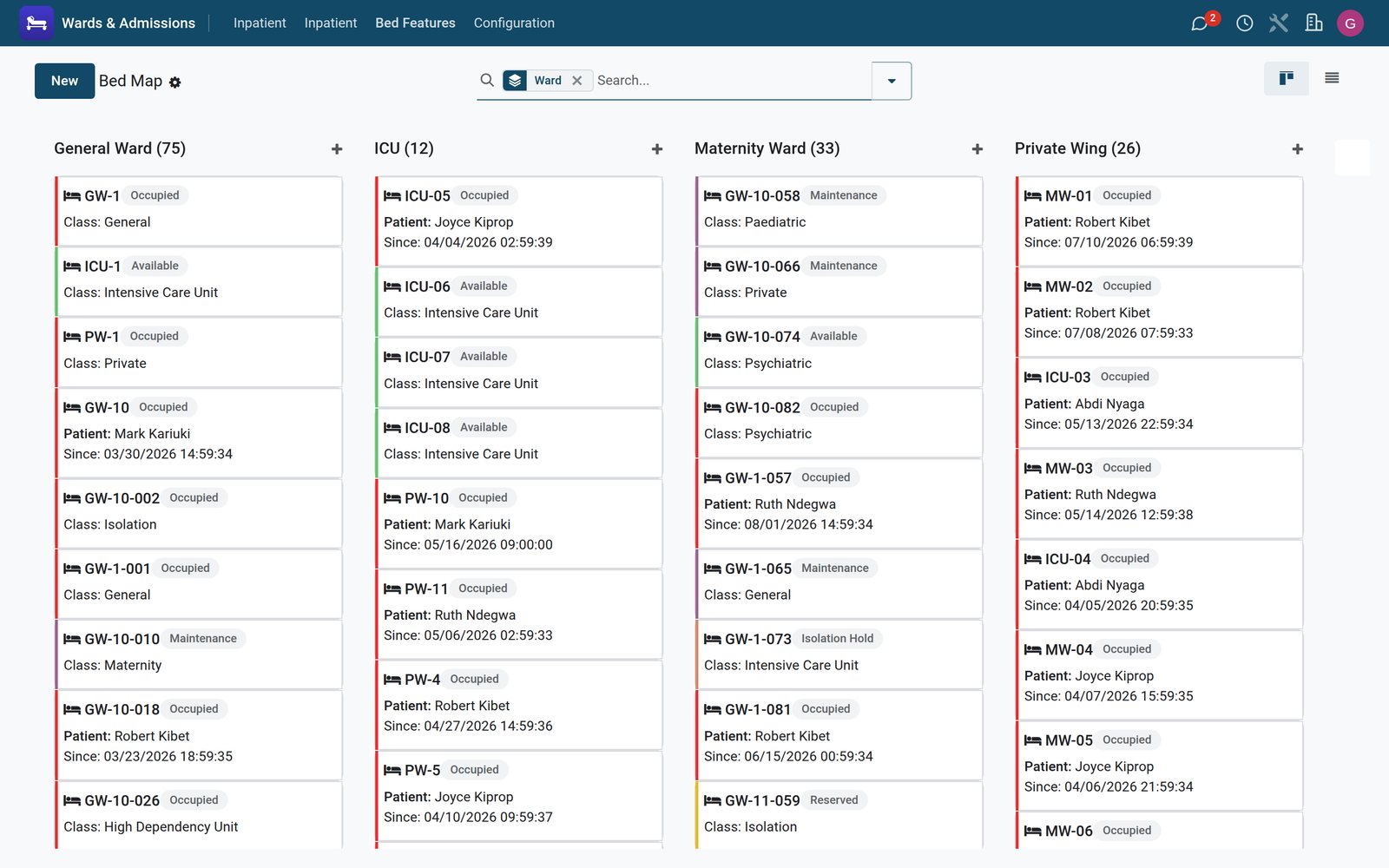
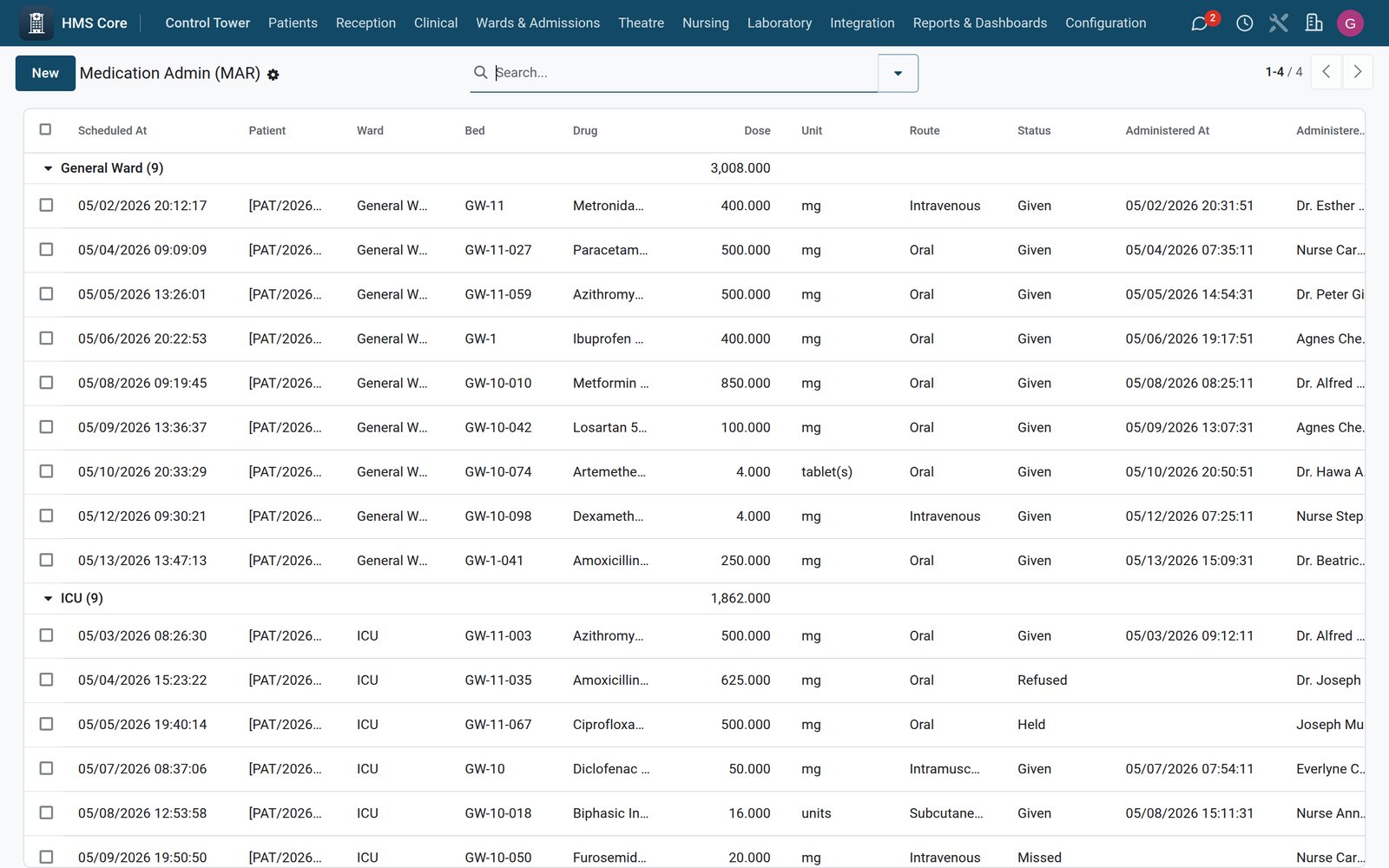
A bed is allocated from the live map, the MAR generates itself from the prescription, vitals score NEWS2 automatically, and the discharge wizard will not close the episode until medication reconciliation and consent are done.

Nursing — Medication administration record

Medication administration record

Nursing

Vitals with early warning

Full vitals capture, Glasgow Coma Scale and an automated NEWS2 score with alert flags and a trend graph per patient.

Explore Nursing →
Wards & Inpatient

Guided transfer and discharge

Transfer wizard hands the bed over and logs the reason; discharge wizard enforces medication reconciliation, consent, final diagnoses and summary.

Explore Wards & Inpatient →
Wards & Inpatient

Bed turnaround

Cleaning records with checklists and duration; a cron releases verified beds back to Available.

Explore Wards & Inpatient →

By the numbers

What ships in the box

Figures taken from the modules as installed, not from a brochure.

40
Departmental apps, from Reception to Biomedical Engineering, each switchable per facility.
8
Country compliance packs, available today for Kenya, Uganda, Tanzania, Rwanda, Nigeria, Ghana, South Africa and Ethiopia.
80+
LOINC-coded tests seeded in the laboratory catalogue with banded reference ranges.
55+
KPI fields captured in every nightly analytics snapshot.
35
Service tariffs pre-loaded in the central price list, with effective-date windows.
30+
FHIR R4 resource types in the interoperability catalogue, plus HL7 v2.5 and DHIS2 export.
A doctor with a stethoscope works on his laptop
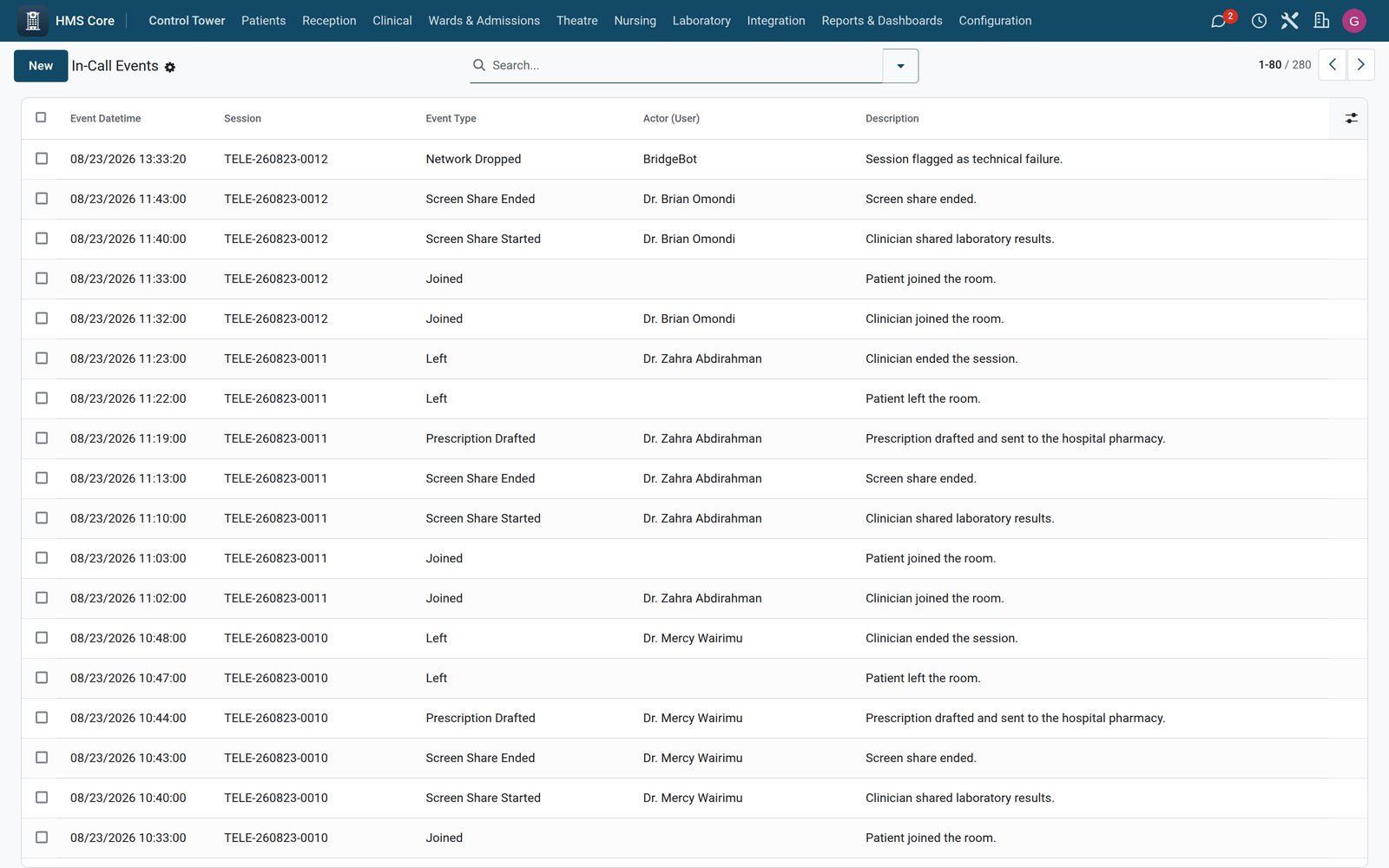
Telehealth in-call events in BridgeERP HMS: patient joined, results shared, prescription sent
In-call eventPrescription drafted and sent to the hospital pharmacy

Telehealth

Care that reaches the patient at home

  • Video consultations logged event by event
  • Lab results shared on screen during the call
  • Prescriptions from the call go to the hospital pharmacy

Management sees the whole hospital

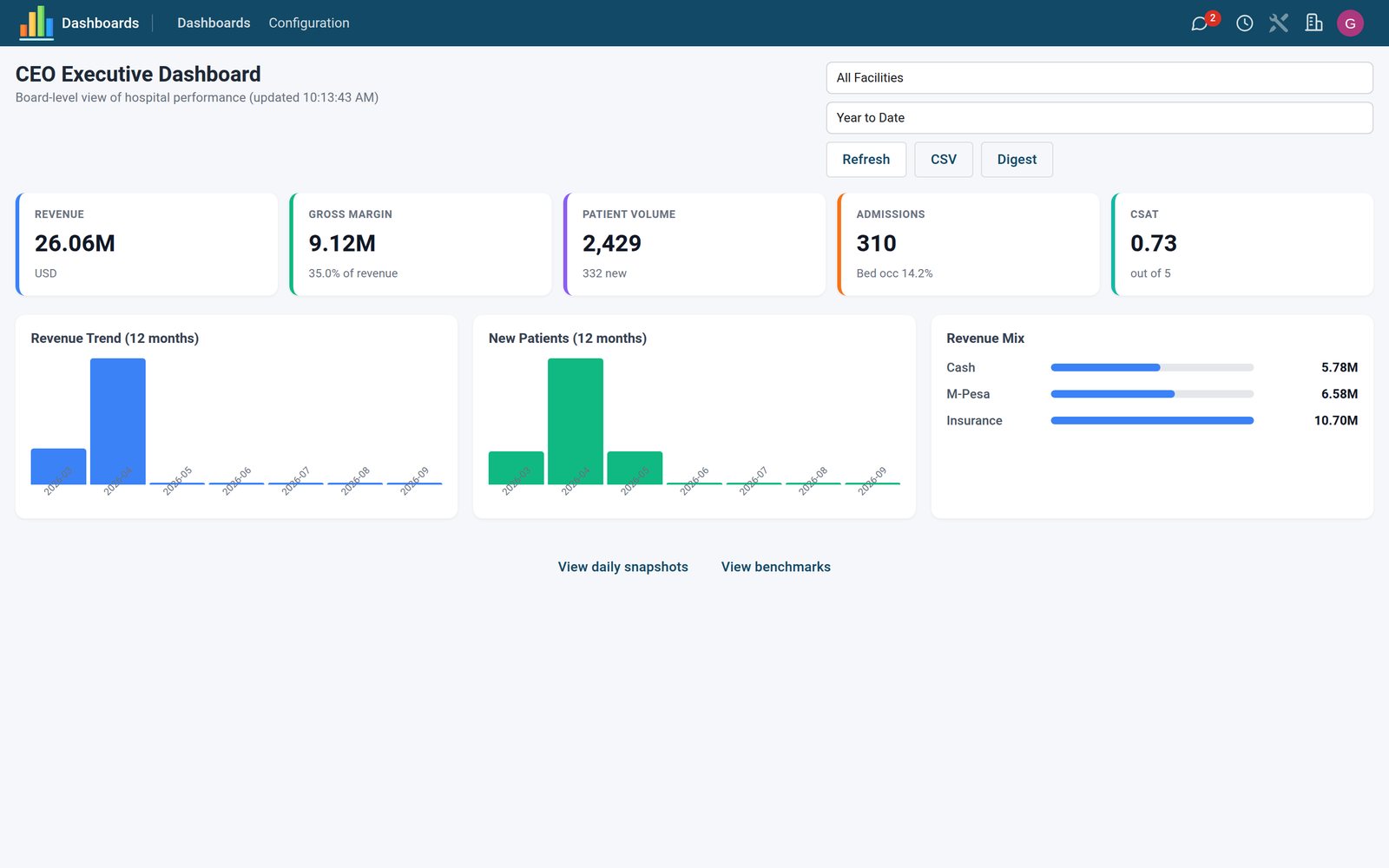
A nightly snapshot engine captures patient volume, inpatient flow, clinical volume and revenue. Executives get CEO, CFO and CMO dashboards, a self-service report builder over eight data sources and scheduled weekly and monthly digests.

Health Analytics — CEO dashboard

CEO dashboard

Health Analytics

Benchmarks with a rating

Twelve pre-loaded industry benchmarks, four benchmark sources and an automatic above / at / below rating per facility.

Explore Health Analytics →
Quality & Accreditation

Quality and accreditation

Incident reporting, audits, indicators and the evidence files accreditation surveyors ask for.

Explore Quality & Accreditation →
A doctor takes a patient's blood pressure at his consulting-room desk

Built for how hospitals get paid, country by country

Identity numbers, schemes, mobile money and statutory registers are first-class fields, not customisations.

  • Mobile money at the desk

    Mobile-money payment details, such as M-Pesa's, captured at reception; multi-method payments and deposits posted to the journal in billing; online bill payment on the portal.

  • National and private insurance schemes

    A seeded insurer catalogue, national scheme capture such as NHIF / SHA, eligibility verification and a national claims API client, such as SHA / SHIF for Kenya.

  • Eight country packs

    Localised claim formats, facility types, patient identifiers and programme registers for KE, UG, TZ, RW, NG, GH, ZA and ET.

  • Controlled-drugs register

    Two-witness authentication, an immutable controlled-substance log and the national register, such as Kenya's PPB register, printed from the pharmacy.

  • DHIS2 and notifiable disease

    DHIS2 export from the interoperability app; notifiable disease reporting, community health workers and campaigns in Public Health.

  • Multi-facility, multi-company

    Wards, tariffs, formularies and reception desks scoped per facility; group hospitals report across companies.

Watch a patient move through the hospital

Real workflows, start to finish — every stop is an app in the suite, and the hand-offs between departments are the product.

Walk-in or booked, arrival to prescription — usually inside an hour.

  • Patient & front desk
  • Clinical
  • Diagnostics & pharmacy
  • Finance
Stage 1 of 9 · Patient & front desk

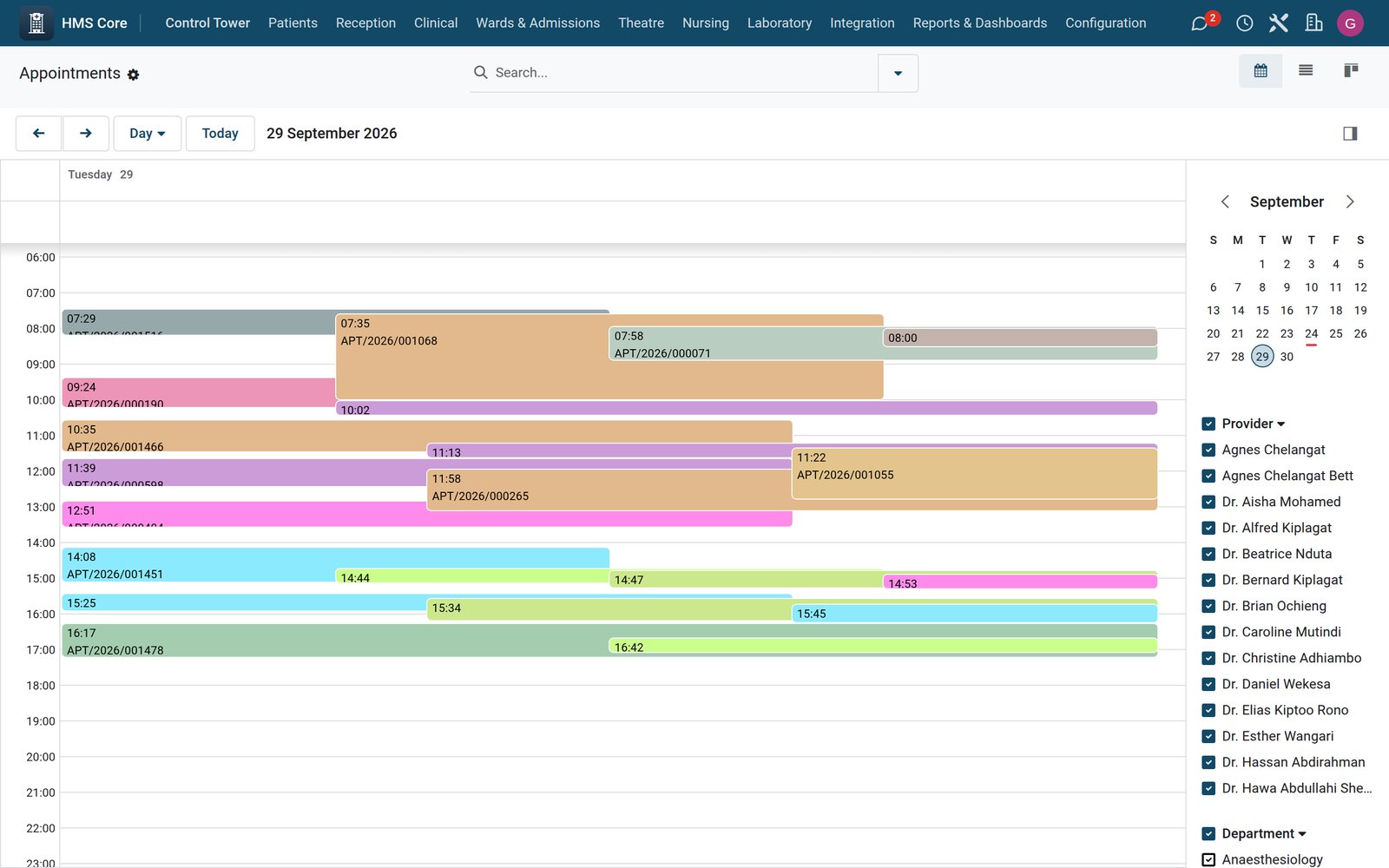
Books a slot

Slot search across providers, rooms and equipment; SMS and portal confirmations.

Appointments →
Appointments in BridgeERP

Getting started

How it works

  1. Build your plan

    Pick the departments your facility runs — from a single clinic to a full hospital — and shape your plan on the pricing page.

  2. Start your free trial

    Instant provisioning, no credit card. Your team explores the suite on a live environment of its own.

  3. Go live

    We help with data import, training and support — talk to us about your rollout.

Questions

Questions about Bridge HMS Suite

Not covered here? Contact us.

How is Bridge HMS priced?

Per practitioner, per month: the clinicians who see patients are counted, and nurses, reception, laboratory, pharmacy and billing staff log in free. The price is a $12 monthly platform base plus a practitioner rate that falls as you grow, from $30 a practitioner for the first five to $8 a practitioner above 200. HMS Core (patient master index, facilities, clinicians, encounters, role security) and the clinic apps, Reception, Appointments, Consultation / OPD, Electronic Health Record, Laboratory, Pharmacy, Billing & Cashiering and Patient Portal, come at no extra charge; hospital departments such as Radiology & PACS, Wards & Inpatient or Operating Theatre each add a share of the practitioner charge. Platform apps like Accounting and Inventory are priced separately.

Can we bring our existing patient records?

Yes. Patients, appointments, tariffs and test catalogues import through the standard BridgeERP import tools, and HMS Core ships a Find Duplicates and Merge Duplicate Patients wizard to clean up records that came in twice. Our go-live team helps with the import, mapping and validation as part of rollout.

Does it take mobile money such as M-Pesa?

Reception captures six payment modes including mobile-money details, such as M-Pesa, at registration. Billing posts multi-method patient payments and deposits to the accounting journal with automatic routing and reconciliation, and the Patient Portal offers an online bill payment page with payment history.

Which insurers and schemes are supported?

Reception seeds an insurer catalogue, Kenya's on the Kenya pack, and captures national scheme details such as NHIF and SHA with eligibility verification. Insurance & Claims runs pre-authorisation, an eleven-state claim lifecycle, batch submission over six channels and a national claims API client such as SHA / SHIF, then reconciles the insurer's remittance statement against claims. Country Compliance adds localised claim formats for Kenya, Uganda, Tanzania, Rwanda, Nigeria, Ghana, South Africa and Ethiopia.

Does it work when the internet drops?

Bridge HMS is a hosted, browser-based system and needs a connection to the server; we recommend a local network with a backup link for clinical areas. Queue tickets and dispense labels print on 80 mm thermal printers, and the insurer API client has an offline simulation mode so claims work can continue and be submitted when the link returns.

We run several branches. Is that one system or several?

One. HMS Core is multi-facility and multi-company: wards, reception desks, formularies and service tariffs are scoped per facility, record rules keep each site's staff on their own data, and Health Analytics reports per facility or across the group.

Which regulatory registers and standards does it cover?

ICD-10 coding across consultations, claims and death certification; LOINC-coded lab tests; the national controlled-substance register, PPB format for Kenya, with two-witness authentication in Pharmacy; Westgard QC and EQA scoring in Laboratory; the WHO surgical safety checklist in Theatre; notifiable disease reporting and DHIS2 export; and FHIR R4 and HL7 v2.5 interfaces for exchange with other systems.

What happens after the free trial?

The trial is provisioned instantly with no credit card on a live environment of its own. When you are ready, we agree the rollout with you: data import, staff training by department and support. Talk to us about the go-live plan before the trial ends.


From front desk to discharge, on one system
One patient record across reception, clinics, wards, theatre, lab, pharmacy and the cash office — with billing and insurance claims built in.