















 : Underwrite, bill and settle on one record
Carrier operations and agency management across life, health, property and liability lines. A policy is a risk contract here, not an invoice with an expiry date: rating, endorsements, earned premium, reserves, cessions and commission all hang off the same record.
Priced per policy in force, with unlimited users.
 Insurance Management
 Insurance Agency Management
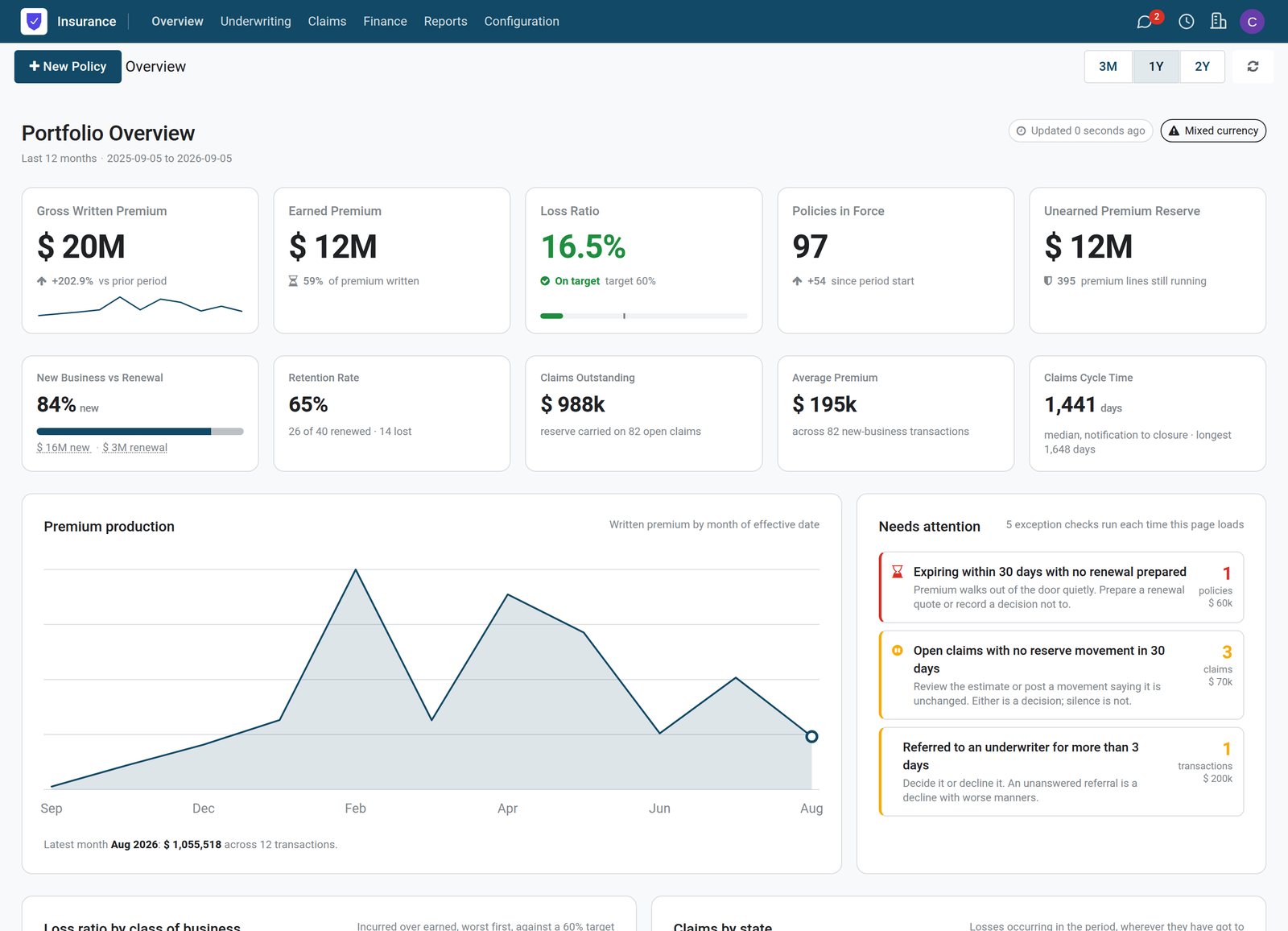
Two sides of the business
Pick the side you run. Carrier and agency install separately; installed together they share one client, one policy and one claim.
Insurance Management (carrier)
Products, rating, submissions, underwriting authority, policies, endorsements, billing and dunning, claims with reserves and fraud indicators, reinsurance, statutory levies and the registers the regulator asks for.
Insurance Agency Management
Book of business by class, X-dates and expirations, certificates of insurance, commission agreements and tiers, carrier statement import with an exception queue, producer payables and draws, contingent and profit-share.

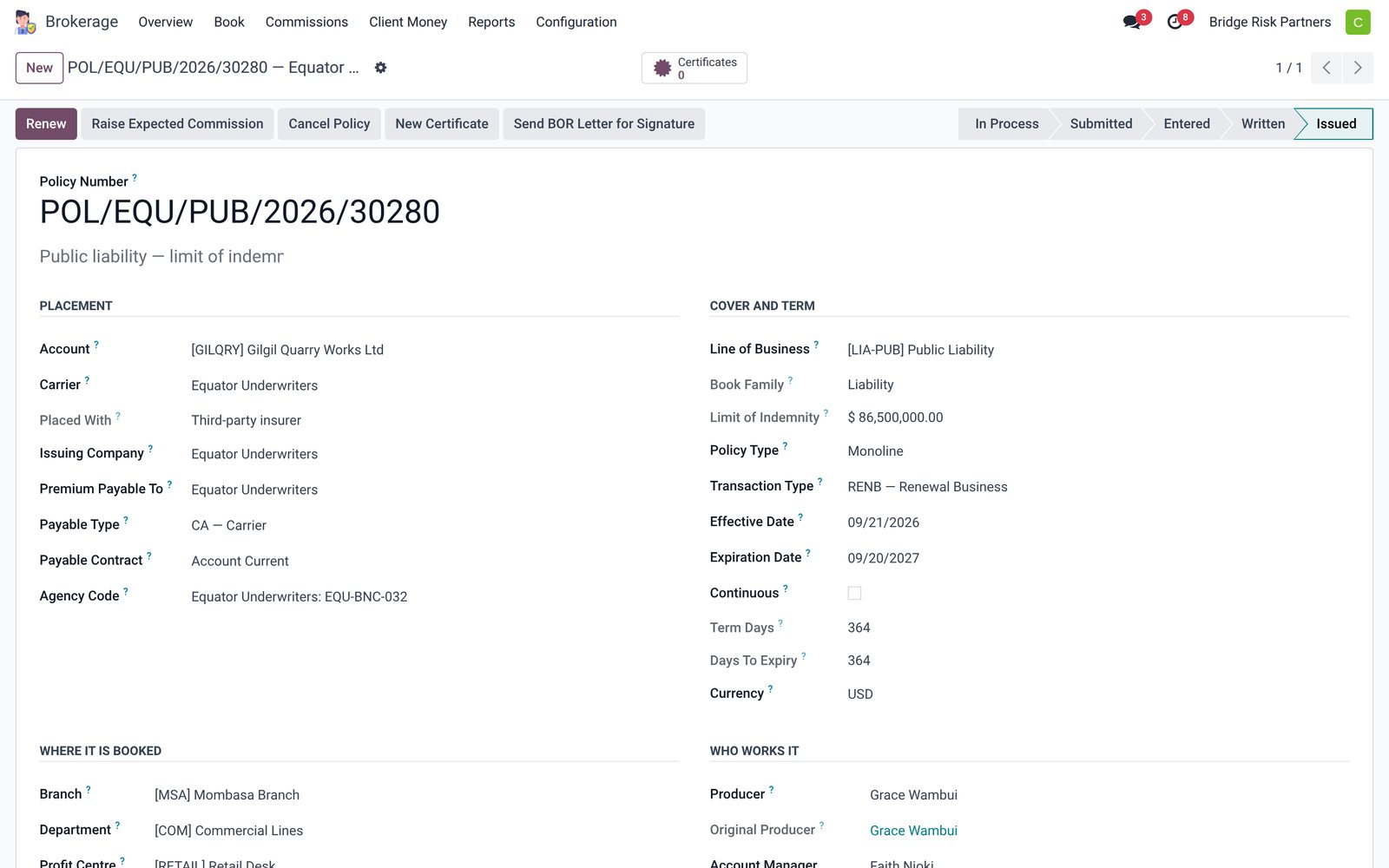
Agents and brokers
Place the risk, keep the commission straight
- Carrier, premium payee and agency code on every placement
- Commission agreements and tiers, with the regulator's cap applied
- X-dates and expirations tracked across the book
Rate, refer, issue. Nothing re-keyed.
A submission carries its quote options and referrals through the pipeline under a service level; the policy that issues from it prints its schedule from the same product definition.
 Insurance Management
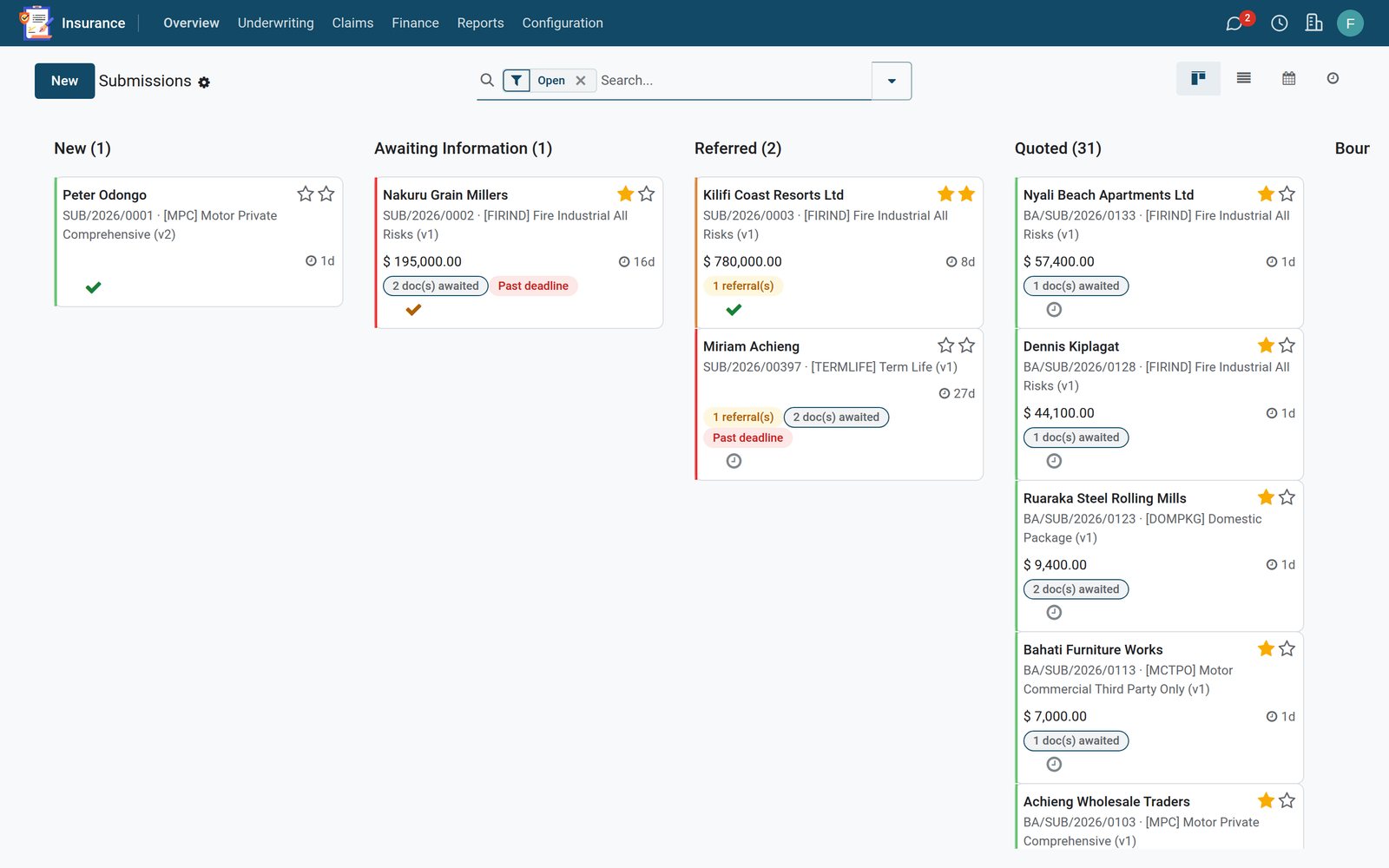
Submissions pipeline
Open submissions by stage, each card with the prospect, product, target premium and days waiting; badges flag referrals, documents awaited and a missed deadline.
Explore Insurance Management →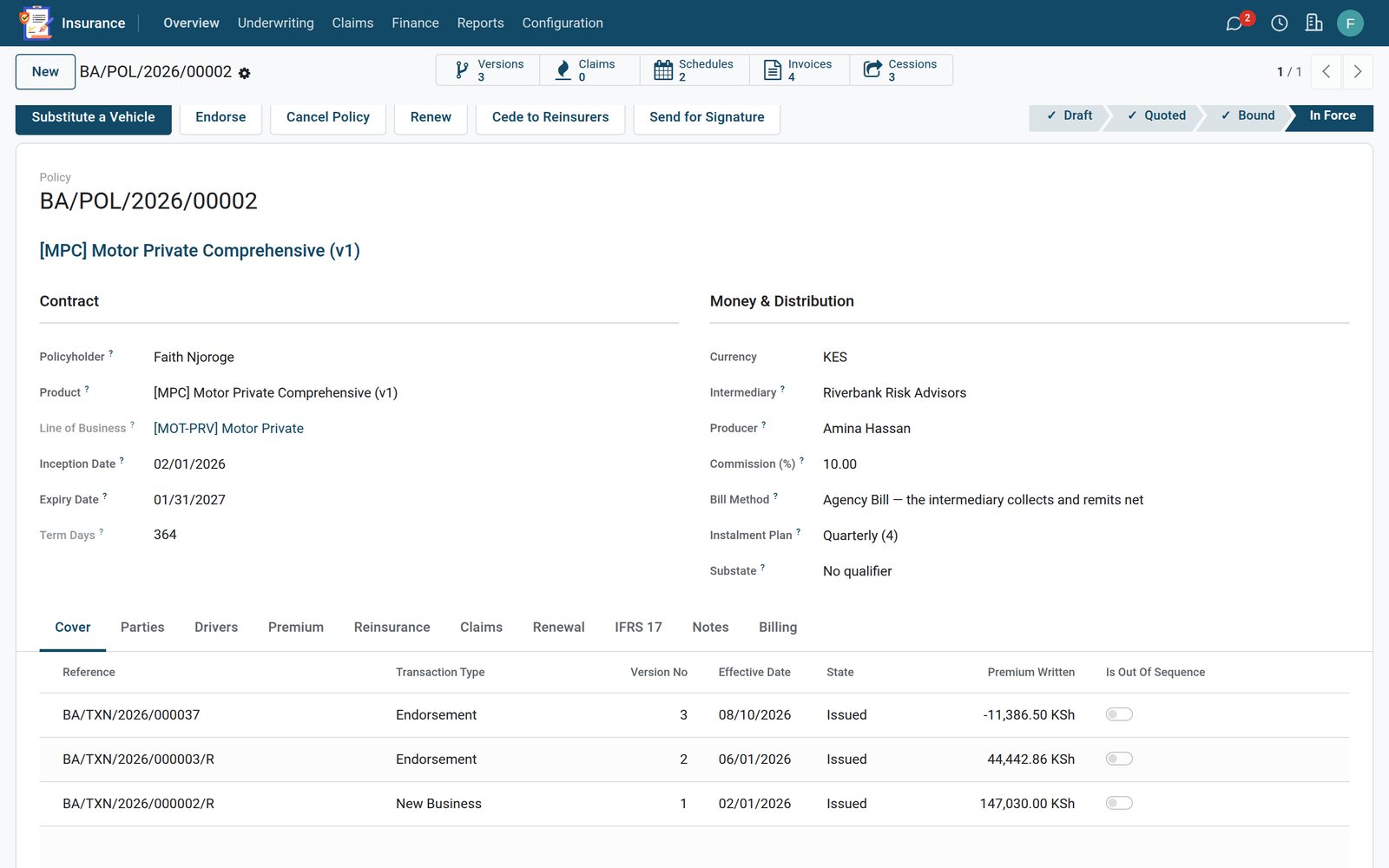 Insurance Management
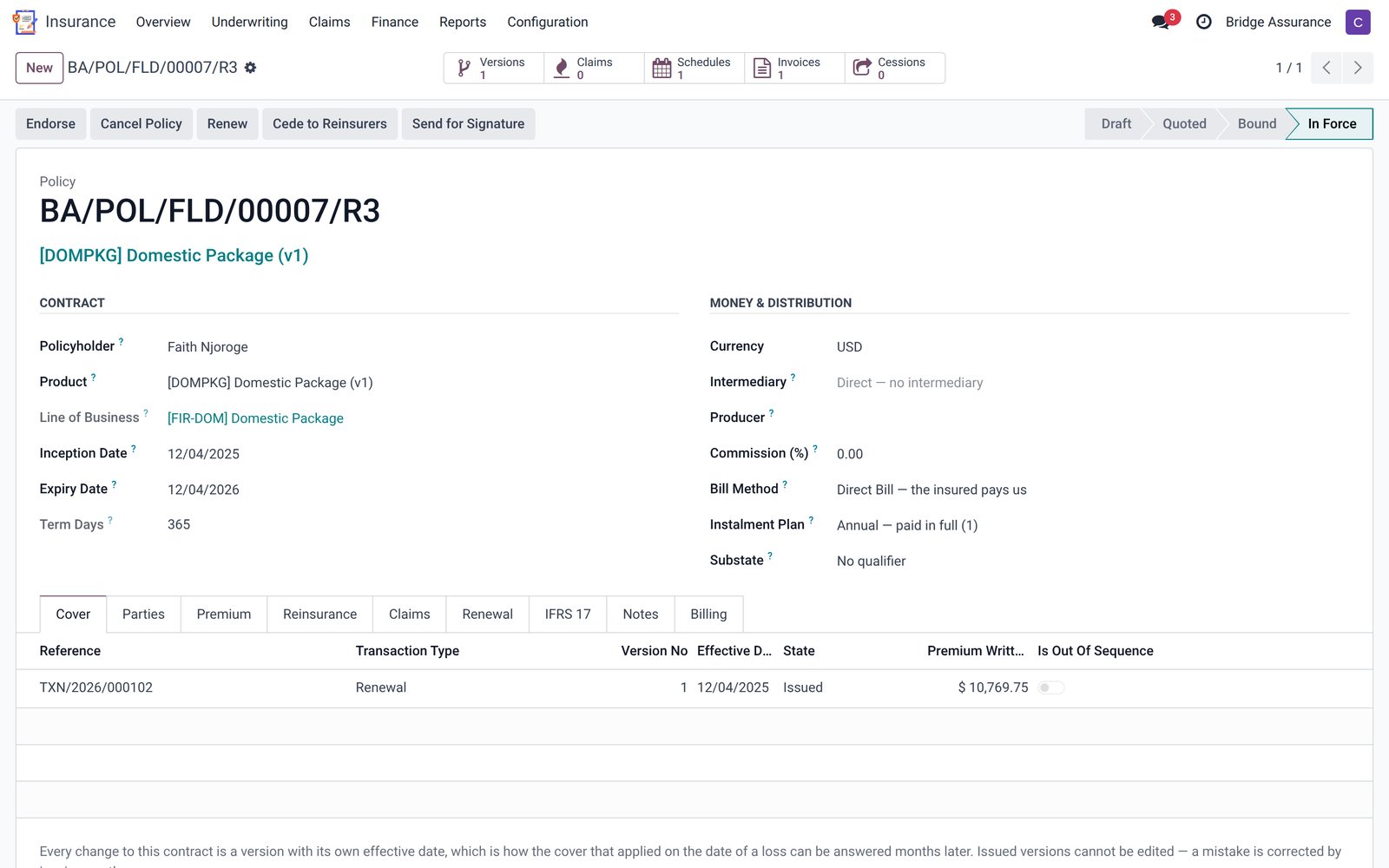
Policy with its transactions
Every endorsement, cancellation and renewal is a versioned transaction on the policy; Endorse, Cancel and Renew are guided wizards that validate before they write.
Explore Insurance Management →What is inside a policy
Every card is a menu in the carrier app, not a roadmap item.
Products, coverages, perils
Versioned insurance products with coverage types, optional coverages and catastrophe-flagged perils; 57 classes of business in the master.
Policy wording
A clause library by code, clause type and version, grouped by class, so the schedule prints the wording the product actually carries.
Proposal questions and document requirements
Per-product proposal questions with typed answers; document requirements that block a stage until the file is on the record.
Endorse, cancel, renew
Three guided wizards. Cancellation applies the short-rate scale; renewals are prepared nightly and lapse if the first premium never arrives.
Eight printed documents
Policy schedule, endorsement schedule, certificate of insurance, renewal notice, premium debit/credit note, claim acknowledgement, discharge voucher, on your letterhead.
Messages on the record's events
Policy issued, endorsement confirmation, renewal notice, premium reminder, arrears notice and final demand before cancellation: templated, translatable, logged on the record.

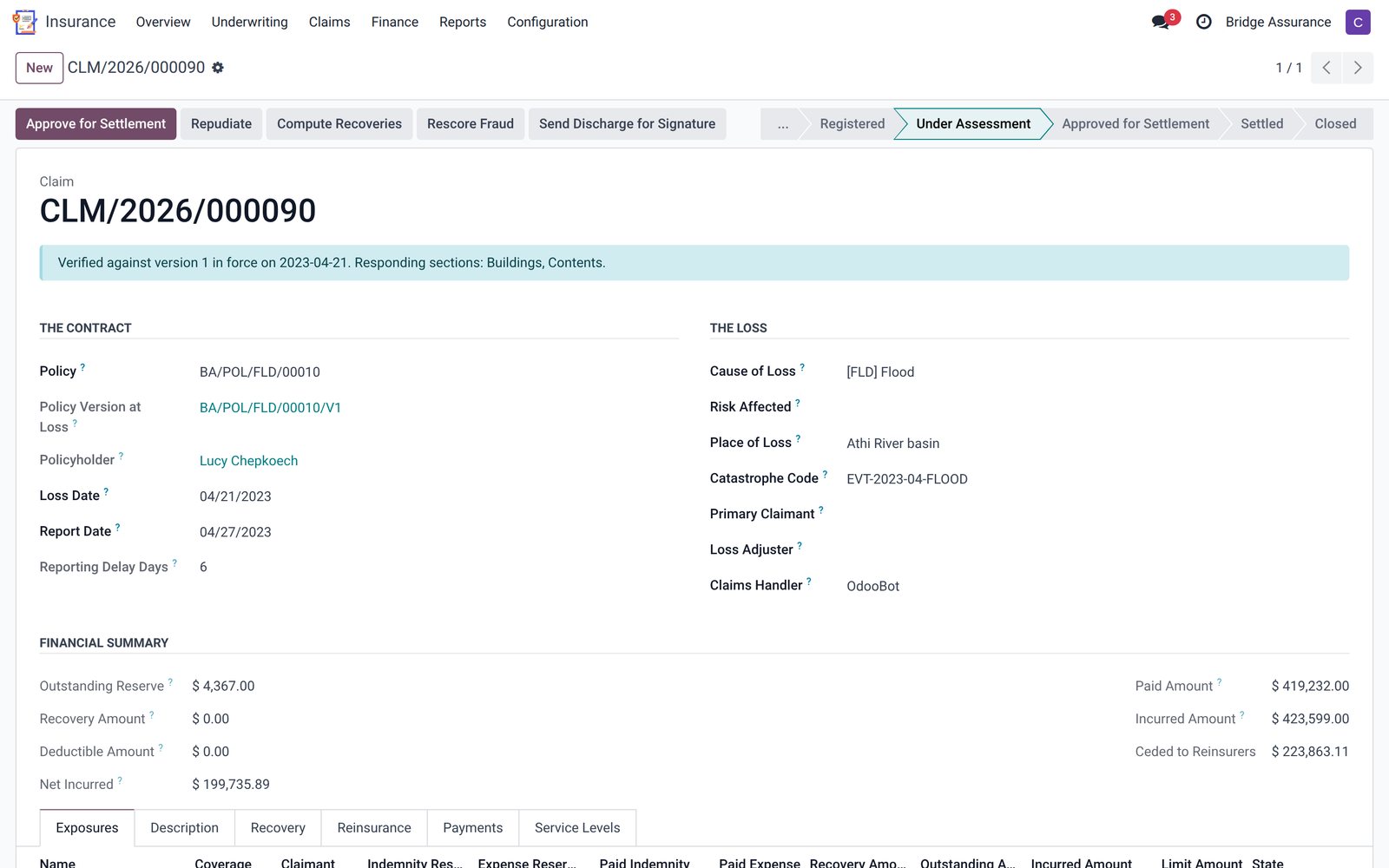
Claims
From first notice to settlement
- Cause, place and date of loss, with the reserve and deductible
- Checked against the policy version in force on the loss date
- Payments, recoveries and the reinsurers' share on the same claim
Instalments billed, chased, collected
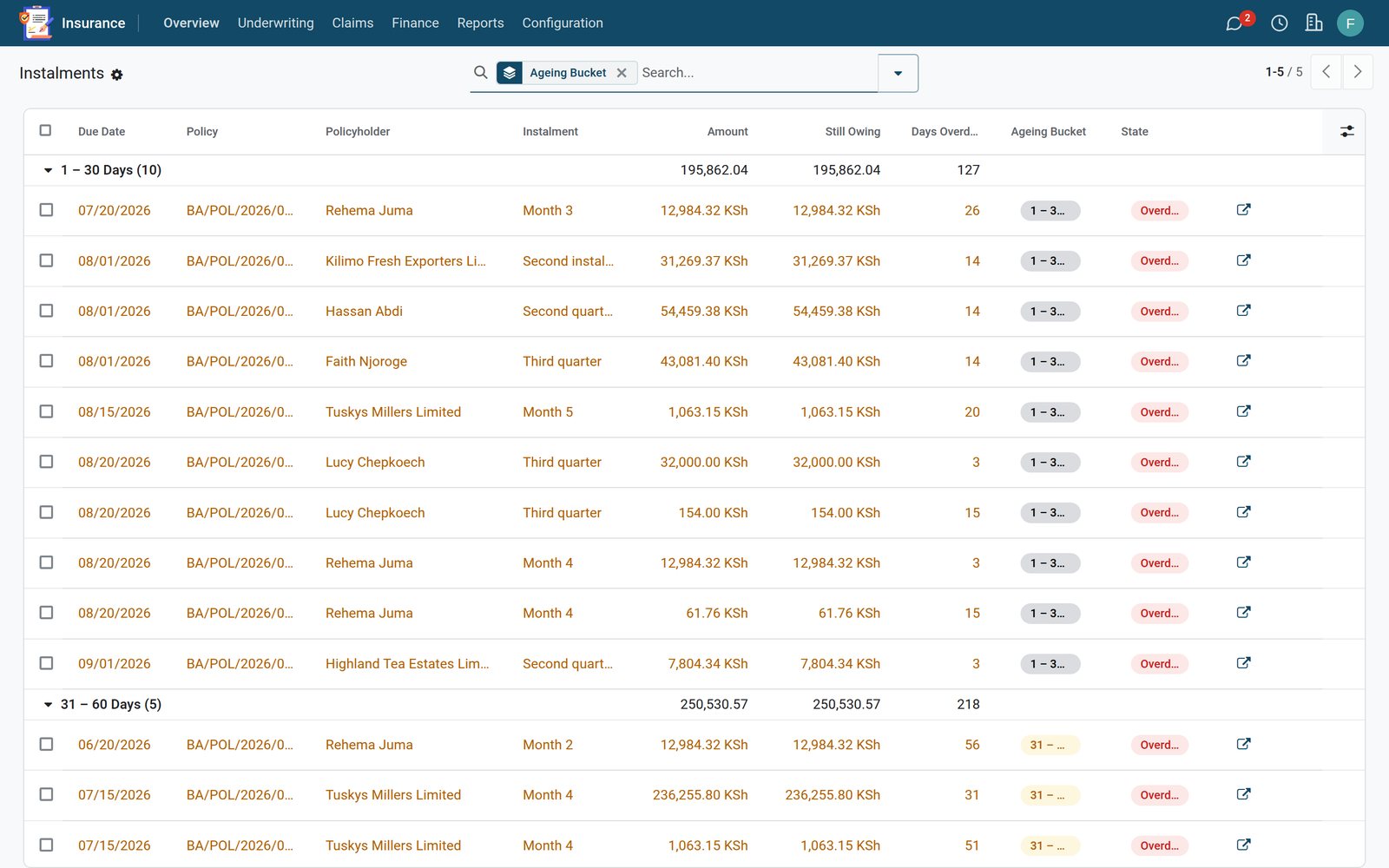
A billing schedule per policy transaction with an instalment plan; overdue instalments move up the dunning ladder every night without anyone opening a screen.
 Insurance Management
Instalments by ageing bucket
One list, grouped by ageing, with premium receivable, paid and outstanding per row. Mobile money is a payment method on the receipt, alongside bank and cash.
Explore Insurance Management →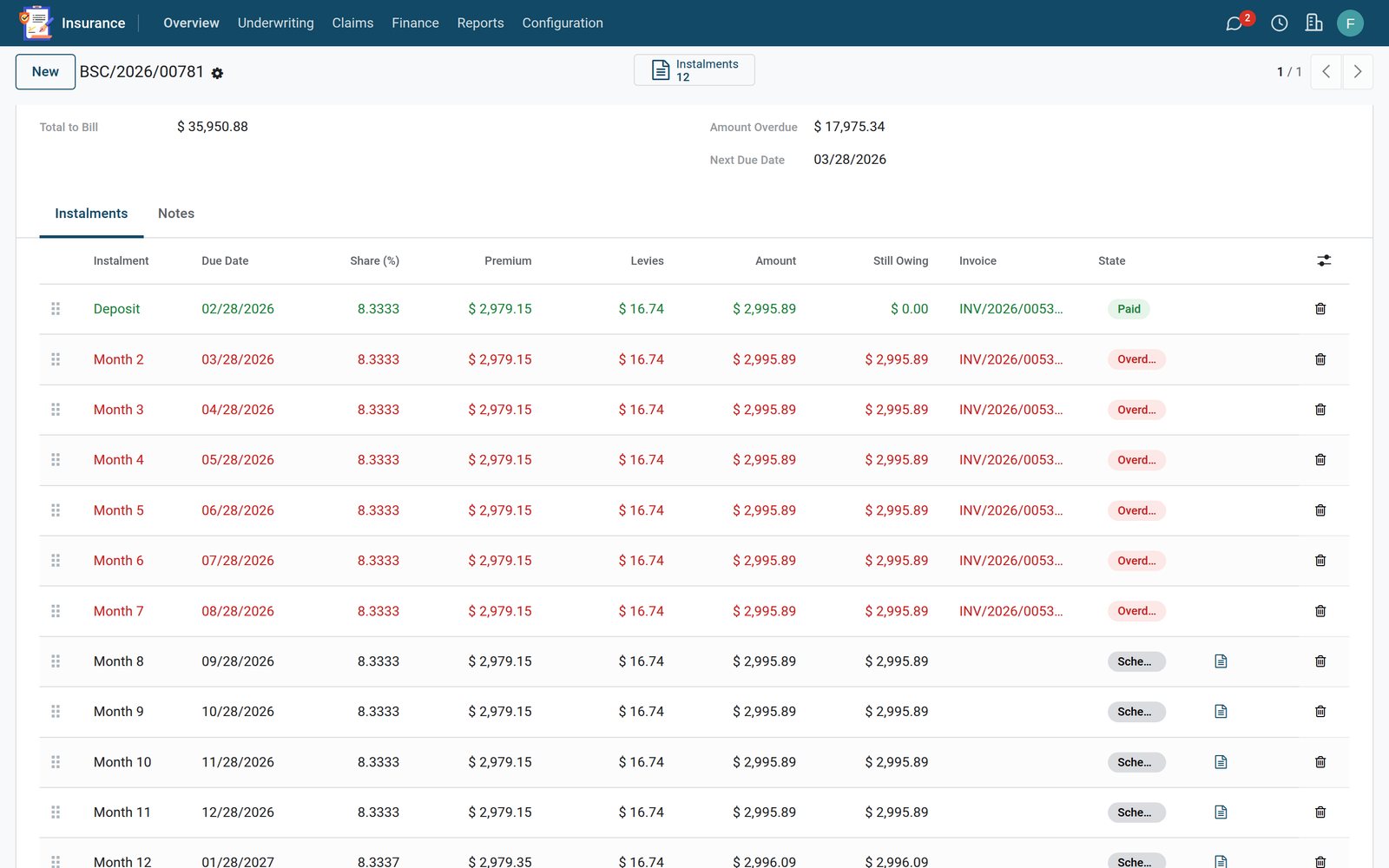 Insurance Management
A schedule with its dunning ladder
Twelve instalments, each with its due date, invoice, state and the reminder that went out; the schedule settles itself when the last one is paid.
Explore Insurance Management →Reserve first, pay second
A claim is a set of exposures per coverage, each with reserve movements, payments, recoveries and the reinsurance share. Fraud indicators are scored and explained before approval.
 Insurance Management
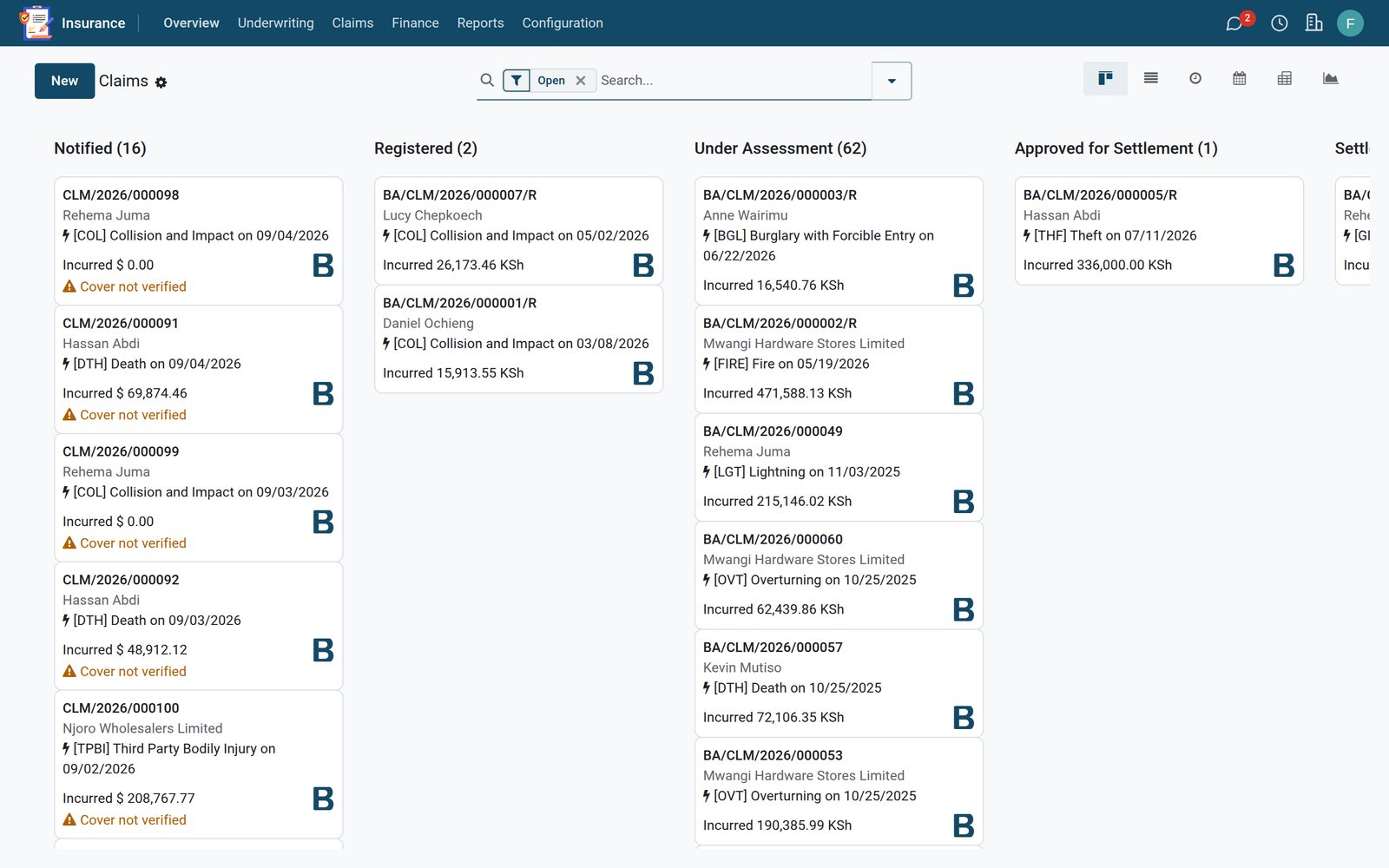
Claims desk
Open claims by stage, each card with the policyholder, cause and date of loss and the amount incurred; the 16 new notifications still show Cover not verified.
Explore Insurance Management →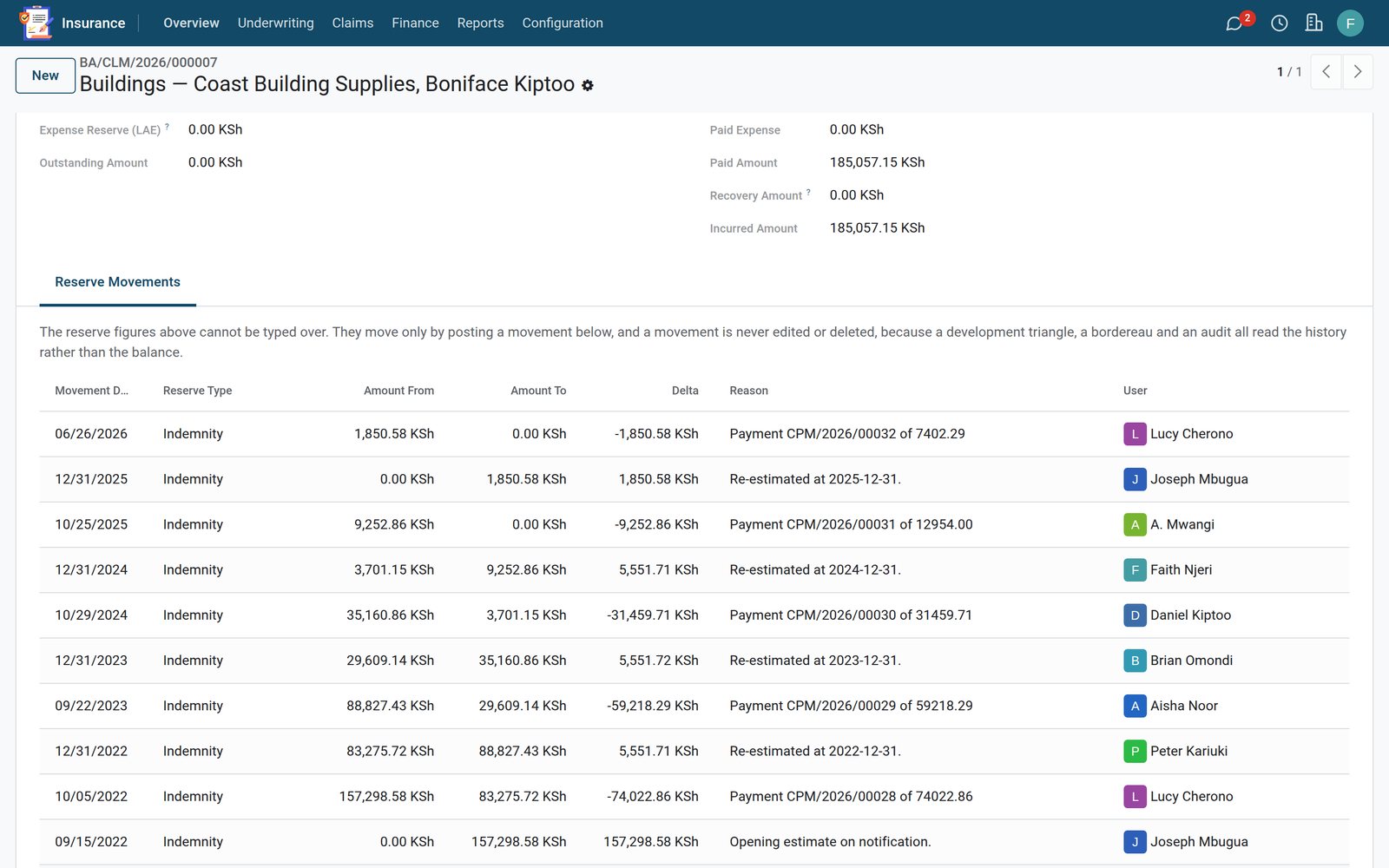 Insurance Management
One claim, ten reserve movements
Exposures by head of damage, the reserve history, five payments and the recovery and salvage tab, all on one form.
Explore Insurance Management →
Policyholders
Every change is a new version of the policy
- Endorse, renew or cancel, with the full version history
- Instalment plan and billing on the policy
- Cessions to reinsurers from the same record
Cessions, levies and country packs
The technical side that store apps skip: treaty programmes, statutory levies by jurisdiction and the measurement basis your auditor asks about.
Treaties, layers, panel
Quota share, surplus, cat XoL with layers and whole-account stop loss; a reinsurer panel per layer with shares and the lead reinsurer. Treaties expire themselves past their period.
Cessions and recoveries
Premium cessions per treaty and treaty year, claim recoveries per exposure, both as list, pivot and graph.
Bordereaux
Premium and claims bordereaux generated per treaty and period with line-level detail for the broker or lead.
Statutory levies and country packs
Levies by country with who bears them (insured, insurer or split), remitted-to body and the levies-collected report; choose the jurisdiction once from Setup > Compliance.
Commission caps
Regulator ceilings per class and policy year applied from the country pack; an agreement above the cap is refused naming the rule.
IFRS 17 measurement and development triangles
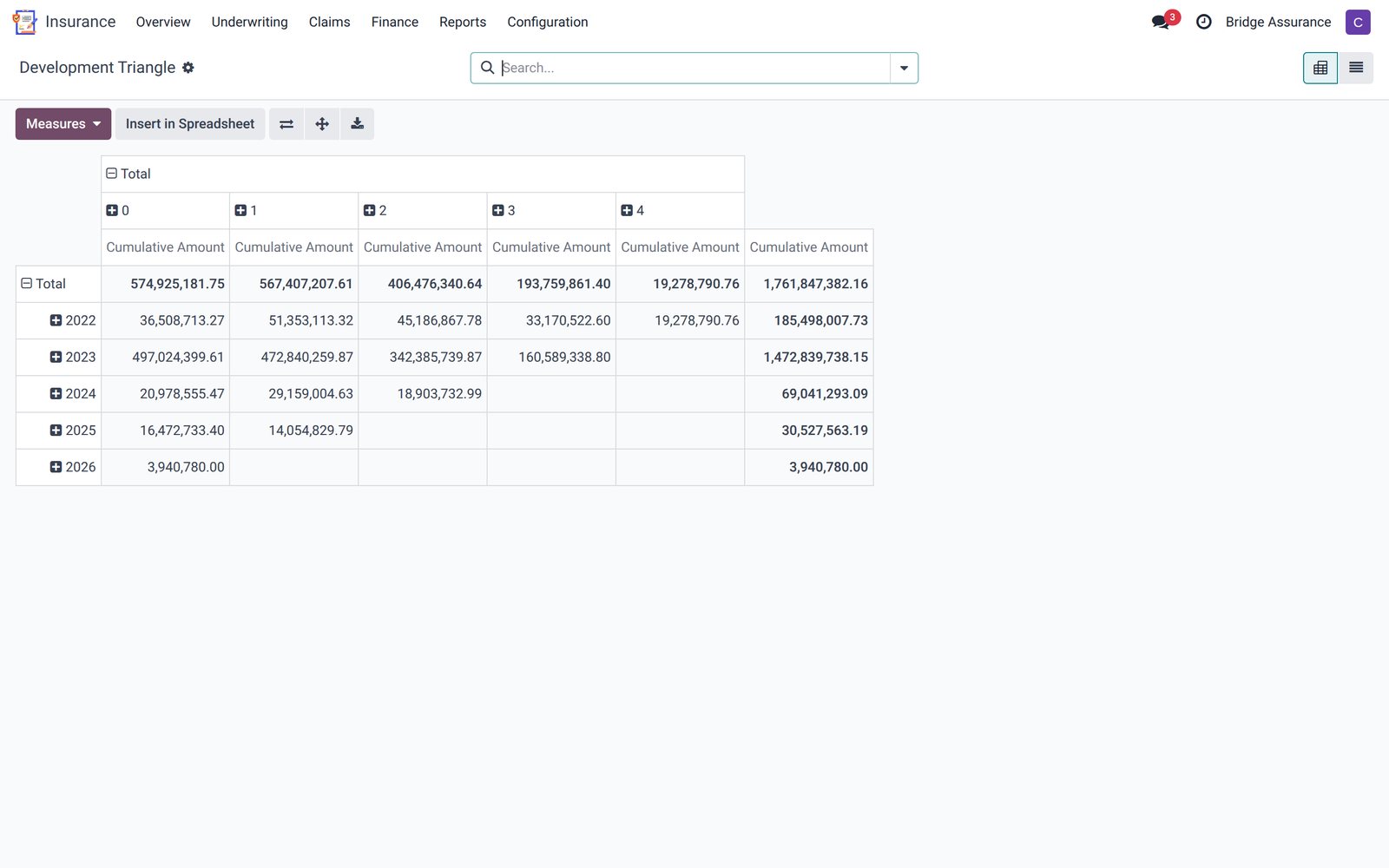
Reserving studies with a valuation date and triangle basis, the development triangle as a pivot, and the IFRS 17 measurement report by period.
The agency book, statement by statement
Policies in force by class, expirations and X-dates to work, then the carrier statement imported, matched and chased, so commission received is reconciled against commission expected.
- Insurance Agency Management
Book of business
Policies in force by class of business, from motor, fire and property, marine and liability to medical, life, bonds and agriculture, with the full-term premium and gross commission of each book.
Explore Insurance Agency Management →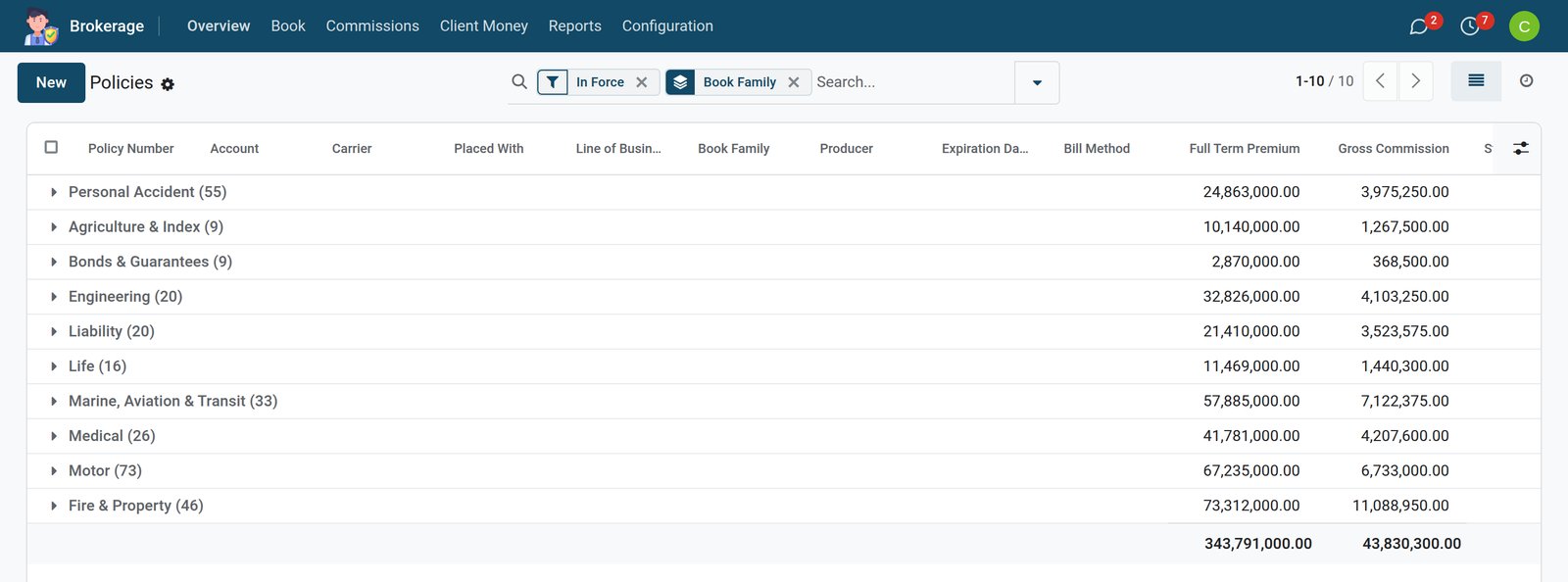
- Insurance Agency Management
Import a carrier statement
Import the carrier's file against its saved layout; each statement carries the carrier's total, the imported total, the variance, its row count and how many lines went to the exception queue.
Explore Insurance Agency Management →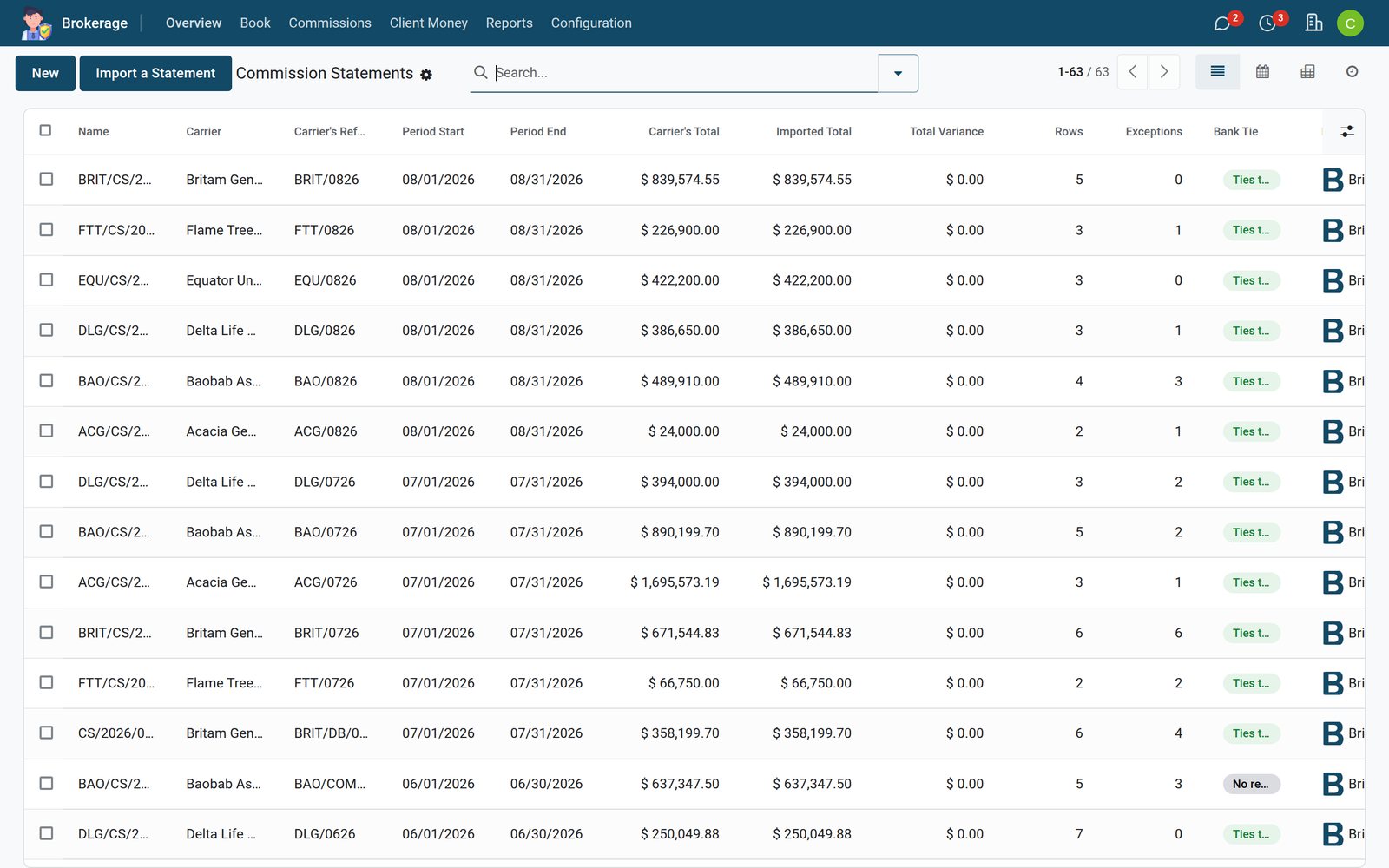
- Insurance Agency Management
Expected vs received
One pivot from the commission ledger: what each carrier should pay, what is owed to producers and what the carrier actually paid, carrier by carrier.
Explore Insurance Agency Management →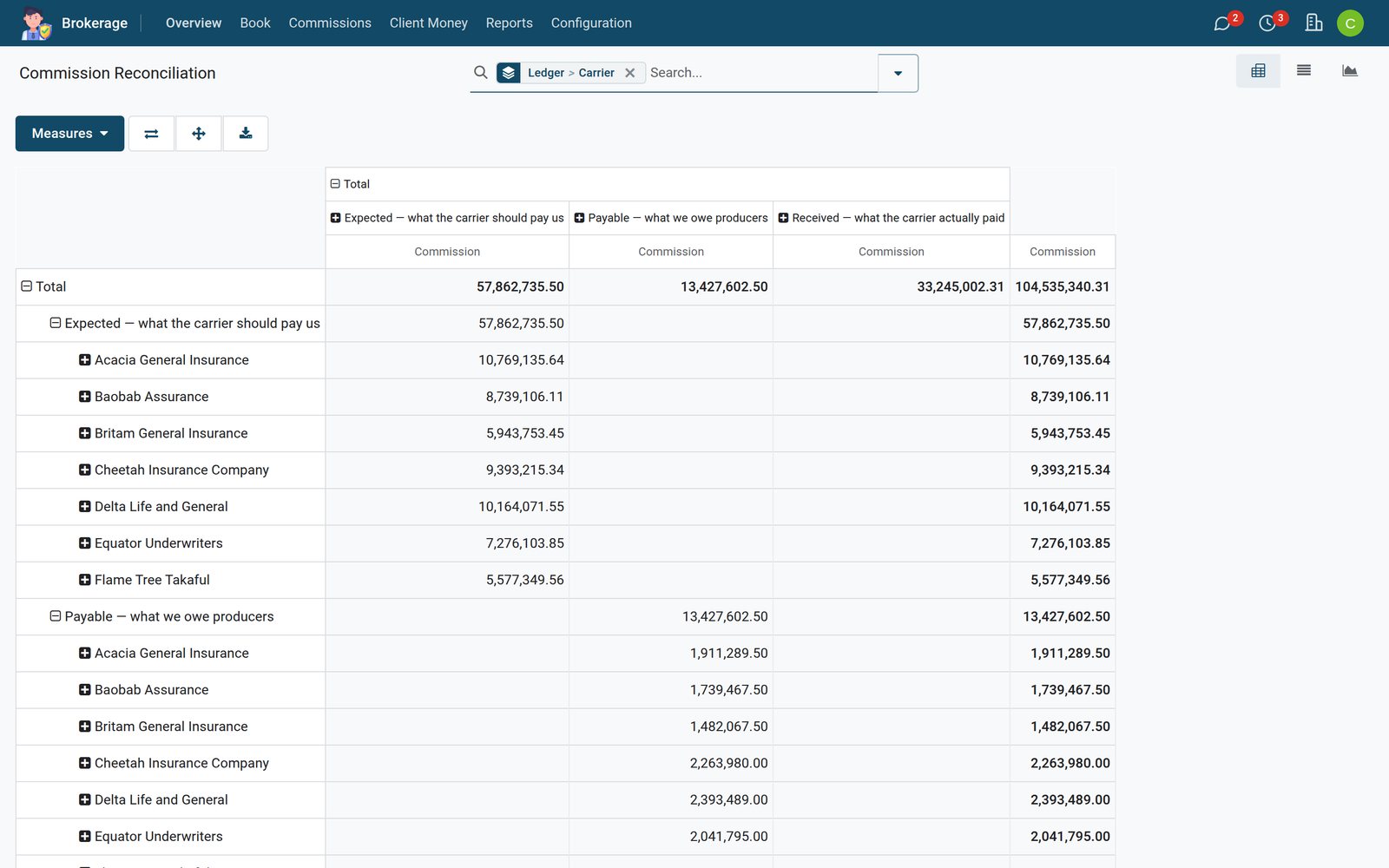

Actuarial and finance
Reserves the actuary can defend
- Development triangles by accident year, as a pivot
- IFRS 17 measurement from the same reserving study
- Unearned premium posted to the ledger every month
By the numbers
What ships in the box
Counts read off the module, not a brochure.
- 57
- classes of business in the lines-of-business master
- 8
- documents printed from the record on your letterhead
- 8
- jobs that run unattended: dunning, instalment invoicing, monthly premium close, renewals, lapses, treaty expiry, claims diary
- 8
- roles enforced at the database, from Sales & Service to Reinsurance and Premium Audit
- 10
- books by class in the agency, from Motor to Agriculture
- 1
- REST API (/api/
insurance/ v1) with API keys and a call log per endpoint

Policyholders serve themselves
The client sees their policies, schedule, certificates, statements and claims on the portal and can report a loss or request a change without calling the branch.
Policies and schedules
Every in-force policy with its instalment schedule, receipts and certificate, downloadable at any hour without a call to the branch.
Report a loss online
A claim starts from the policy page with photos and documents attached, and lands in the claims queue with its SLA clock already running.
Changes without a phone call
Endorsement, beneficiary and cancellation requests are logged against the policy and answered from the same record the underwriter works in.
Getting started
From first look to go-live
Three steps, each with a person on our side.
1. Pick your side
Carrier operations or agency management, or both together.
2. See it live
Book a session and walk the suite on a live environment with a full demonstration book.
3. Go live
Data import, country pack selection, training and support from our team.
Quote to claim, on one platform
The agency sells and services; the carrier underwrites and pays. Both sides of the transaction, one record.
A motor quote on Monday, a settled claim months later — nothing re-keyed.
- Client
- Agency
- Carrier
Quote prepared
Product, cover and client details captured once, compared across carriers.
Insurance Agency Management →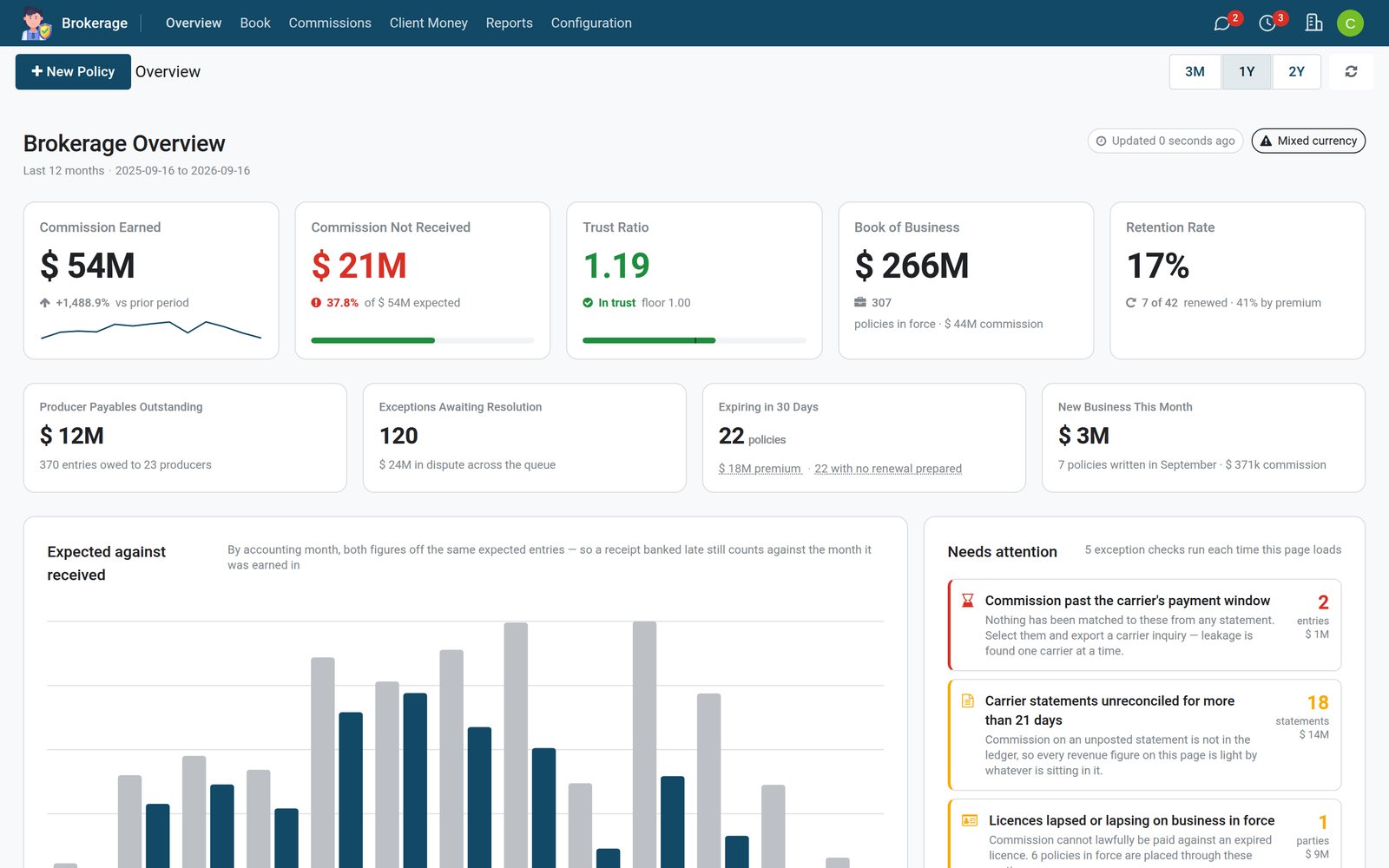
In the suite
Two apps, one policy record
Carrier operations and agency management — pick the side of the business you run.
- Insurance ManagementPolicies, claims and premiums across life, health, property and liability insurance.No extra charge
- Insurance Agency ManagementInsurance agency operations across life, health, property and liability lines.No extra charge
Plus the whole BridgeERP platform
The same plan can carry any of these: one login, one database, no integrations to buy. Pick them app by app on the pricing page; every plan already includes BridgeERP Core.


























Questions
Questions about Insurance Suites
Not covered here? Contact us.
How is the suite priced?
Per policy in force, per month, never per staff login: every plan carries unlimited users. The price is a $9 monthly platform base plus a policy rate that falls as your book grows, from $0.12 a policy for the first 1,000 to $0.01 a policy above 100,000. Insurance Management for carriers and Insurance Agency Management come at no extra charge, and a carrier and an agency can each take one side without the other. The pricing page shows the exact monthly figure for your book before you commit, beside the published prices of the leading policy platforms.
Can we bring our existing policies, clients and claims across?
Yes. Accounts, policies, policy lines, claims and commission agreements import through the standard BridgeERP import on every list; the agency also has Import a Statement for carrier commission files against a saved statement layout. Historic instalments and reserve movements can be loaded so ageing, retention and loss reports read your real history from day one.
Do premiums and claim payments work with mobile money?
Mobile Money is a payment method on premium receipts in the agency and on claim payments in the carrier, alongside bank transfer, cheque and cash, so the record shows how the money moved. Live wallet rails for your country are a platform integration on top; ask us which operators are covered where you operate.
Does it work offline?
The apps run in the browser and the mobile app and need a connection to the server. What does not wait for a user is the scheduled work: dunning, instalment invoicing, renewals, lapses, treaty expiry and the claims diary run on the server every night whether or not anyone is logged in.
How does it handle our regulator's requirements?
You choose your jurisdiction once from Insurance Setup > Compliance. The country pack brings the statutory levies with who bears each one, regulator commission ceilings by class and policy year, and the statutory premium and claims registers. Reserving studies, development triangles and IFRS 17 measurement are built in for the technical side. A figure we cannot cite ships inactive and visibly marked, never applied silently.
We have several branches and producers. Does the agency handle that?
Yes. The agency app has Branches, Departments and Profit Centres, producer splits per policy, commission paid out by producer and by branch, and producer payables with draws recovered across statements. On the carrier side, multi-company runs on BridgeERP Core, so a group with more than one licensed entity keeps separate books.
Can other systems talk to it?
The carrier exposes a REST API at /api/insurance/v1 secured by API keys issued to a named party, with every call logged under Reports > API Calls, so a partner portal or a rating front end can quote and read policies without direct database access.
What happens between the demo and going live?
You walk the suite on a live environment with a full demonstration book, then our team imports your data, applies your country pack, trains each role (Sales & Service, Underwriter, Claims Handler, Finance, Manager, Reinsurance) and supports you through the first close. Support continues after go-live under your agreement.
Carrier and agency, one platform
Policies, claims and agency operations across life, health, property and liability lines.